There’s never a good time to reduce ad spend, but the challenges and uncertainties brought on by the COVID-19 pandemic were too great for most brands to ignore, driving widespread advertising cutbacks across channels and markets. The pause in spend likely had an adverse effect on brand awareness for many companies, which means that now is the time to get back in the game—but with a strategic, well-balanced approach.
É atípico que o conhecimento da marca caia a zero - mesmo quando as marcas ficam no escuro por longos períodos -, mas o conhecimento da marca se deteriora, e é por isso que é normal ver marcas muito conhecidas manterem campanhas publicitárias robustas mesmo em condições normais de mercado. Seu único objetivo é combater a deterioração. Portanto, é provável que grande parte do aumento da publicidade nos EUA ocorrido em agosto tenha se concentrado no reconhecimento e não na ativação.
And that’s something that should continue as the ad market continues to come back online. On average, it takes three to five years to recover equity lost because of halted advertising, and long-term revenue can take a 2% hit for every quarter a brand stops advertising. Brand building and awareness campaigns are critical in long-term success, and companies that were able to frugally maintain their marketing efforts through the past three historic ad shocks were able to protect up to 9% of total sales annually. Said plainly, playing the long game is critical. In fact, the long-term impact of marketing is 88% higher than the short-term impact.
Sometimes it takes a bit of experimentation to get the balance right. For example, global sports brand Adidas reported last October that it needed to pivot after over-extending itself across digital channels and performance marketing in an effort to super-charge ROI. Ultimately, it found that the focus on cutting back had a negative effect on brand awareness.
Transição da conscientização para o interesse
O interesse é a outra consideração crítica do topo do funil e está intimamente ligado à conscientização. Os dados de previsão de vendas da Nielsen mostram que há uma relação quase linear entre interesse e vendas (por exemplo, um aumento de 10% no interesse levará a um aumento de 10% nas vendas). Dada a natureza reviravolta do mundo em 2020, não é surpreendente ver as marcas recuando, protegendo seus gastos e concentrando-se em apostas seguras, como descontos entregues digitalmente e promoções enviadas por mala direta aos clientes atuais. Essas táticas orientadas para a ativação são importantes, mas não funcionam isoladamente. Elas também podem não funcionar em situações em que as empresas pausaram os esforços de reconhecimento da marca em meio à incerteza do mercado.
Understanding consumers’ reality is also critical. Given the depressed economy and resultant job losses, pitching financially constrained consumers with activation-geared marketing efforts after a period of silence might not generate the desired response. It could even turn consumers off for good. For example, in our “Adapting to a New Normal” webinar earlier this year, we noted that 41% of consumers are more likely to buy from a brand that uses its advertising to explain what it’s doing to help its employees and customers.
Dada a situação do cenário de mídia e publicidade, é provável que as marcas precisem se concentrar em equilibrar a construção da marca com iniciativas de incentivo às vendas, mas nenhum profissional de marketing deve tomar decisões de canal e alocação sem as métricas adequadas. Os profissionais de marketing precisam equilibrar a construção e a ativação da marca. Elas não são intercambiáveis, e o foco em uma em detrimento da outra sem métricas de medição adequadas pode levar a gastos ineficientes.
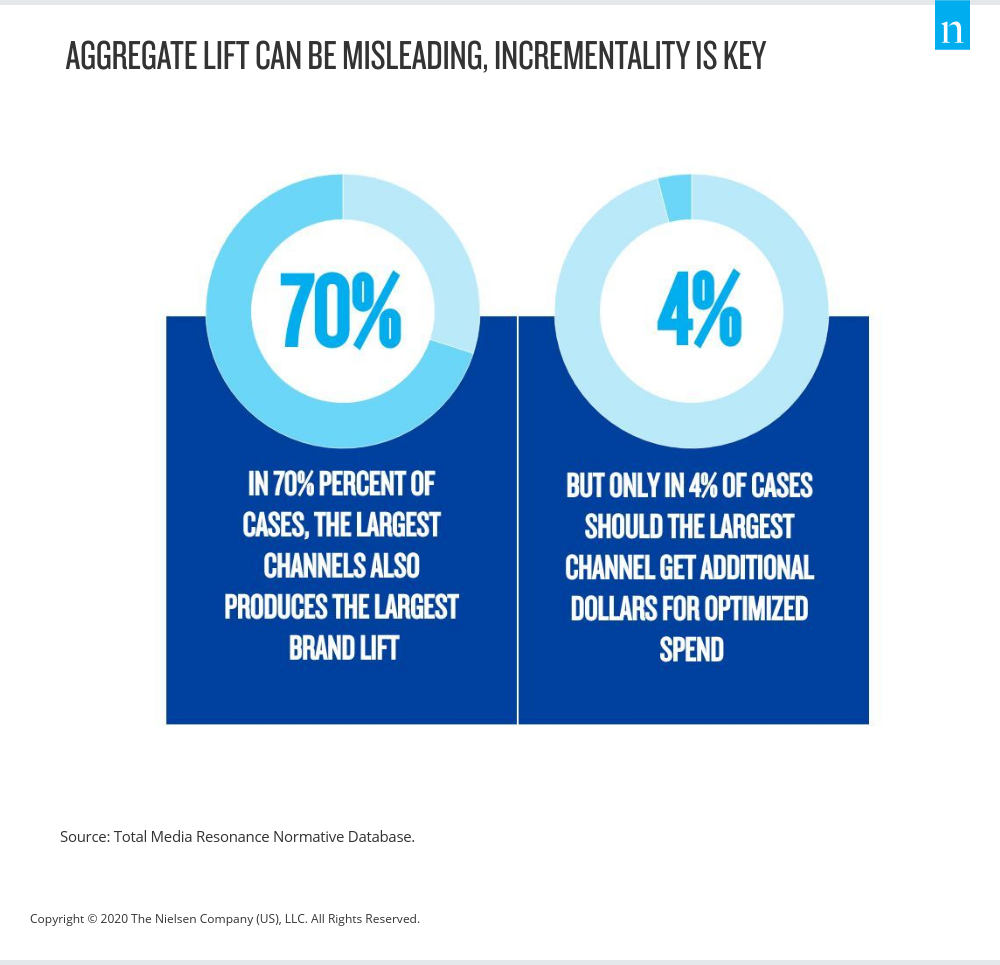
It’s also not wise to simply add additional spending to the areas that drive the greatest brand lift. Data from Nielsen Total Media Resonance shows that the channel with the greatest spend drives the greatest lift 70% of the time. So a brand should expect its biggest channel to drive the greatest brand lift, but that doesn’t mean additional spend there will automatically drive incremental lift. It likely won’t. In fact, the channel with the greatest lift only has the greatest marginal efficiency 24% of the time. And according to Total Media Resonance analyses, increasing investment in your largest channel is actually an ineffective choice for growing brand health in 96% of cases.
O marketing é uma combinação de construção de marca e ativação de vendas, mas em meio a uma pandemia global que mudou todos os aspectos da vida diária dos consumidores - e que provavelmente continuará a mudar no futuro próximo - os profissionais de marketing precisam de uma medição precisa, com foco principal na otimização, para saber como ajustar suas iniciativas em um ambiente em rápida evolução. As estratégias de ativação de vendas podem gerar ganhos de curto prazo, mas as análises do Nielsen Marketing Mix Modeling mostram que cerca de metade do impacto do marketing nas vendas ocorre muito tempo depois do lançamento inicial da campanha, destacando a força poderosa que a construção da marca tem sobre as vendas finais.