AI is no longer a futuristic concept—it’s here, and it’s reshaping marketing. What started as a new technology has quickly become a core strategic need for businesses worldwide. From predicting which products a customer is likely to buy next to automating the personalized delivery of ad campaigns across multiple channels, AI is transforming not just how marketers operate, but also how brands connect with their audiences. For marketers, that means re-evaluating strategies and skill sets.
Kształtowanie perspektyw na przyszłość
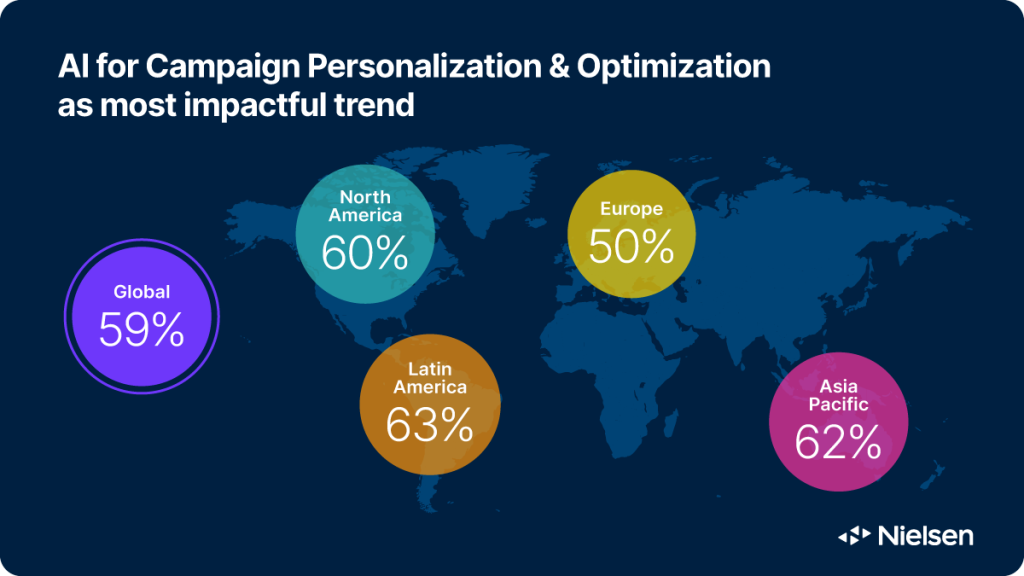
Nielsen’s 2025 annual global marketing survey found that marketers recognize the profound potential of AI in marketing to reshape customer engagement and operational efficiency. They’re increasingly seeing how AI can fundamentally change how they connect with customers, personalize interactions, and streamline their daily workflows—making their efforts far more impactful. Indeed, its perceived impact is remarkably high across the industry. For 59% of global marketers, AI for campaign personalization and optimization is the most impactful industry trend poised to make a difference by 2025. AI’s prominence stems directly from its proven capabilities. Take, for instance, how AI now powers dynamic ads that adapt in real-time to individual user profiles, or predicts next-best actions for hyper-personalized customer journeys, moving far beyond basic segmentation to truly individualized experiences.
Across regions, marketers recognize AI’s transformative power for personalization. In Latin America, 63% of marketers prioritize it, with Asia-Pacific closely following at 62%. Prioritization also runs high in North America, where 60% see AI for personalization as a top trend, and even in Europe, AI maintains a significant focus for 50% underscoring a global consensus that AI is the key to unlocking future growth and delivering tailored customer experiences.
While marketers see AI as the top trend of 2025, marketers’ strategic foresight extends beyond a singular focus. They are simultaneously mindful of other critical trends in their industry, seeing those as carrying significant future impact. For instance, 51% of global marketers are prioritizing the rise of sustainable and purpose-driven marketing, reflecting a strong global commitment to values. Authenticity and influencer content is another impactful trend, with 47% expecting its significant influence.
Wyższy poziom pomiarów marketingowych
Beyond personalization, marketers are also recognizing AI’s impact in marketing measurement, where its capabilities are now widely applied across many tasks. Digital campaigns today generate huge amounts of data, more than people can manually track. AI makes understanding this torrent of information possible by swiftly processing vast, disparate datasets.
Marketerzy wykorzystują sztuczną inteligencję, aby poprawić sposób, w jaki rozumieją i optymalizują kampanie, zapewniając, że dane napędzają mądrzejsze decyzje. Na całym świecie 50% firm wykorzystuje sztuczną inteligencję do zapewniania jakości. Sztuczna inteligencja okazuje się tutaj niezbędna, zapewniając dokładność i wiarygodność danych marketingowych - kluczowy fundament każdej skutecznej strategii. Ale AI robi znacznie więcej niż tylko czyszczenie danych.
Content creation sees significant AI involvement, with 47% of companies utilizing it. 44% also employ AI for customer segmentation, intelligently dividing up audiences by various traits and behaviors, and 42% use it for personalization, tailoring experiences based on those granular insights. For instance, Delta introduced its AI-powered Delta Concierge in 2025, a digital tool designed to create seamless and personalized moments within the Fly Delta app, giving customers more control and confidence in their travel experience.
Marketers also find AI invaluable for strategic decision-making, particularly through advanced analytical capabilities. Predictive analytics, for example, used by 46% of companies, enables forward-looking insights by forecasting future trends and customer behavior. Even creative aspects benefit from AI’s analytical power—43% of companies leverage it for creative evaluation, assessing the effectiveness of visual and messaging elements.
Understanding audience sentiment is also a key application, with 39% utilizing AI for sentiment analysis to gauge opinions and emotions from social media and customer feedback. AI’s diverse and powerful applications bring incredible versatility, transforming how marketers operate. It provides deeper, more actionable insights, guiding smarter decisions and allowing you to fully understand what’s working across all their efforts.
Odpowiedzialne poruszanie się po prywatności cyfrowej
Constantly adapting to shifts in consumer expectations and regulatory environments is key to staying relevant, maintaining compliance, and achieving sustained growth. A significant 42% of marketers worldwide recognize the impact of changing data privacy rules and the move toward a cookieless internet browsing. They recognize they are facing fundamental shifts in how they understand and measure audiences, which means they need to find new, privacy-compliant strategies to continue delivering personalized and effective campaigns. Google’s initial plan to end third-party cookies on Chrome in 2020 spurred a global search for new marketing solutions. While Google no longer plans to remove these cookies, it instead is implementing a new system, letting users select their preferred tracking options across its search products.
Niezależnie od konkretnych decyzji dotyczących platformy, ważne staje się znalezienie zaawansowanych sposobów interpretowania sygnałów od odbiorców i optymalizacji dostarczania, w mniejszym stopniu polegając na tradycyjnym śledzeniu. Takie nowe środowisko sprawia, że sztuczna inteligencja w marketingu jest niezbędnym narzędziem, ponieważ oferuje możliwość zrozumienia zachowań odbiorców, przewidywania preferencji i optymalizacji kampanii przy użyciu danych własnych i sygnałów kontekstowych, zamiast polegać na plikach cookie stron trzecich. W ten sposób reklamodawcy mogą nadal dostarczać spersonalizowane doświadczenia i odpowiednie reklamy, jednocześnie szanując prywatność użytkowników.
Obecny stopień zastosowania AI w marketingu
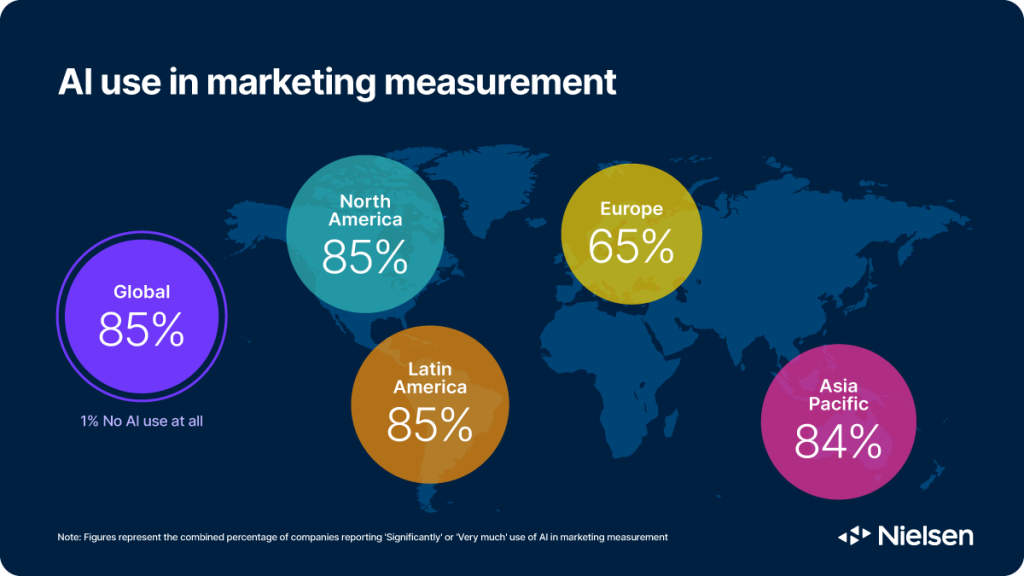
A substantial 80% of companies worldwide indicate a notable commitment, employing AI either significantly or very much in their measurement efforts. However, regional variances in AI adoption, much like any other technological innovation, are evident across markets. How swiftly and profoundly AI integrates into marketing practices is notably influenced by a region’s technological infrastructure, its regulatory environment concerning data privacy, and the prevailing business priorities or availability of skilled talent.
North America and Latin America are setting the pace, both at 85%, with Asia-Pacific right behind at 84%. Europe, however, shows a slightly lower overall adoption at 65%. It’s truly remarkable that only a tiny 1% of companies globally report no AI use at all, making it evident that AI has indeed become widely accepted across the world—just at different levels.
While AI’s pervasive adoption marks a significant turning point in marketing, its evolution isn’t happening in isolation. You need to navigate a dynamic industry shaped by multiple forces beyond just AI. In such a constantly changing landscape, clarity is your strongest asset. It’s time to move beyond uncertainty and take control of your strategic marketing success.
Download the 2025 Annual Marketing Report: From Chaos to Clarity: Unlocking the Power of Data-Driven Marketing now. Transform challenges into powerful opportunities and confidently shape your future success.
* Uwaga: Dane pochodzą z globalnego rocznego badania marketingowego Nielsen z 2025 roku.