Jeśli nie opowiesz własnej historii, zrobi to ktoś inny. Dla ludzi z Bliskiego Wschodu/Afryki Północnej (MENA) jest to rzeczywiście wyzwanie, jeśli chodzi o historie, które widzą w mediach. Dane Nielsena pokazują, że obecność MENA na ekranie wynosi zaledwie 2,5% w 1 500 programach telewizyjnych, kablowych i streamingowych. Ale to nie tylko media niedostatecznie reprezentują tę grupę. W rzeczywistości amerykański spis powszechny nadal klasyfikuje osoby z MENA jako białe, pozostawiając populację, która musi ciężej walczyć o zasoby, ponieważ jest niedostatecznie reprezentowana i liczona. Co więc może zrobić branża medialna, aby zwiększyć reprezentację MENA na ekranie i opowiedzieć dokładniejsze historie o ich doświadczeniach?
To explore some ideas and opportunities, we spoke with Dr. Evelyn Alsultany, Associate Professor, Department of American Studies and Ethnicity at University of Southern California, and educational consultant for the MENA Arts Advocacy Coalition (MAAC), an organization that advocates for greater visibility of Middle Eastern, North African, and South Asian talent in Hollywood.
"Spożyliśmy tak wiele obrazów i historii, które stereotypowo przedstawiają Arabów, Irańczyków i muzułmanów oraz oczywiście wiele innych grup. Ich szkodliwość nie polega na jednej historii, ale raczej na ich powtarzaniu i braku różnorodności w obrazach. W rezultacie stereotypy reprezentują całą grupę ludzi i pozbawiają ich człowieczeństwa".
Dr Evelyn Alsultany
Q: From 2019-2021, Nielsen data shows that the genres where MENA talent is most often seen are biographies, action sports and dark comedies. From your research/experience, what stories about MENA culture are being told on screen? Are there stereotypes or accurate representation/depictions?
O: Hollywoodzkie filmy i programy telewizyjne nie są "tylko rozrywką". Stereotypowe obrazy i ich powtarzanie w historii wpływają na poparcie dla polityki, która szkodzi Arabom i muzułmanom. Mają one ogromny wpływ i konsekwencje. MAAC zbudował większą świadomość na temat MENA w branży rozrywkowej w 2017 roku jako nową kategorię różnorodności, pomagając społeczności zyskać uznanie i umożliwiając firmom takim jak Nielsen i innym właściwe zmierzenie tego, jak wygląda reprezentacja MENA na ekranie. Wciąż jednak nie jest to wystarczające.
There have been some notable changes over the last two or three decades. After 9/11, there was an increase in “good” Arab and Muslim characters in TV shows like 24, Ojczyzna oraz Jack Ryan. However, these characters appeared as U.S. patriots who either worked for the FBI or CIA or who were willing to fight and die for the U.S. to prove their patriotism. It is an improvement over portrayals as terrorists but it is nonetheless a very limiting character that defines Arabs and Muslims as “good” or “bad” in relation to terrorism and in relation to a very narrow conception of patriotism.
P: Czy wraz ze wzrostem treści na platformach streamingowych i cyfrowych widzimy więcej kultury/ludzi z MENA na ekranie?
Przeszliśmy od czasów, gdy większość ludzi oglądała ten sam zestaw programów w telewizji sieciowej, do tak szerokiej gamy programów oferowanych za pośrednictwem usług streamingowych. Mamy również większy dostęp do produkcji spoza USA. Istnieje tutaj duży potencjał w zakresie dywersyfikacji obrazów, które konsumujemy o ludziach z MENA.
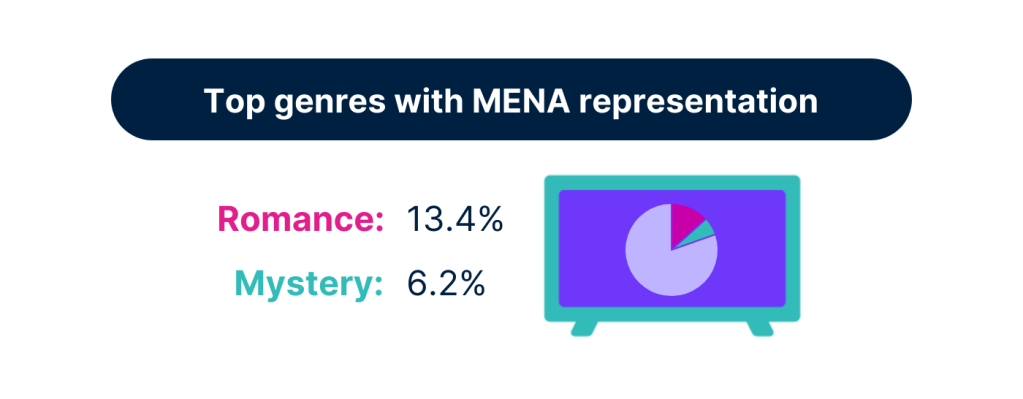
Historically,non-Arabs would play Arab roles and would use costumes and accents to convey Arabness. Anthony Quinn, who was Mexican, played Arab characters in several movies: The Road to Morocco, Lawrence of Arabia (1962), and Lion of the Desert (1981). As recently as 2014 and 2016, Gerard Butler was in Gods of Egypt, and both Christian Bale and Joel Edgerton in Exodus: Gods and Kings were all painted brown to play MENA Characters. Most of the roles left available for MENA actors over the last two decades have been stereotypical characters. Even when MENA talent is present, there is still a need to expand the stories that are told about them. Nielsen’s Gracenote Inclusion Analytics data shows that romance was the top genre where MENA talent appeared on screen in 2021—almost twice more than in mystery, which is the genre with the second highest MENA share of screen. And when we look at the programs under the romance genre, 40% is in Spanish-language novelas, which is limited to the Spanish audience.
Luckily, we have content creators like Ramy and Nasim Pedrad helping to change the landscape. But we need more streamers and networks to buy MENA content from MENA creators and put it on air. With TV more global than ever, there is a market for it. We’ve seen a concerted and notable effort in Hollywood to expand and improve representations especially in response to the Muslim Travel Ban proposed in 2015. As a result, we saw an increase in representations of Muslims outside of terrorism. It is quite refreshing. These include CBS’ FBI, Fox’s 9-1-1: Lonestar, the CW’s DC Legends of Tomorrow, Freeform’s The Bold Type, NBC’s Transplant, Hulu’s Ramy, Peacock’s We Are Lady Parts, and most recently Disney+ Moon Knight. These shows have been impacting the MENA audience in moving ways for their accurate and thoughtful representation.
P: Co jeszcze można zrobić, aby wprowadzić zmiany?
Najskuteczniejszym podejściem będzie to, które ma na celu naprawienie historii reprezentacji, a nie chwilowego kryzysu.
Dr Evelyn Alsultany
Over the last five years, some wonderful resources have emerged to support Hollywood in diversifying representations. The MENA Arts Advocacy Coalition, MAAC, works to educate the industry at large on the underrepresentation of MENA in entertainment and has created a database of MENA and South Asian creatives to connect emerging and established talent from these regions to the industry. The WGA launched a Middle Eastern Writers Committee to create awareness for MENA Writers, and SAG-AFTRA recently created a National MENA Committee to advocate for performers.
But devising effective solutions requires developing a fuller understanding of the problem. The problem is not one movie or TV show, but how a history of stereotypical representations has constructed negative meanings about Arabs (and Muslims) that have real world consequences. The problem is that MENA performers have been portrayed as terrorists so many times that it has come to represent the entire community of 300 million people. Therefore, we need to encourage streamers and networks to invest in MENA talent and hire MENA writers.
Zwykle staramy się rozwiązywać problemy, gdy wybuchają lub gdy pojawia się kryzys, taki jak zakaz dla muzułmanów. Jednak najskuteczniejszym podejściem będzie to, które stara się naprawić historię reprezentacji, a nie chwilowy kryzys.