2019-2020 닐슨 비재무적 중요성 평가
Updated responsibility & sustainability non-financial materiality assessment highlights Nielsen’s commitment to proactive engagement with its stakeholders
요약
비즈니스 전반에 걸쳐 의미 있는 지속적인 개선을 위한 노력의 일환으로, 닐슨은 세 번째 비재무적 중요성 평가를 위해 닐슨 내부 및 외부의 이해관계자들을 참여시켰습니다. 이해관계자의 의견을 적극적으로 청취할 수 있는 이러한 기회는 현재와 미래에 걸쳐 비즈니스와 지역사회에서 직간접적으로 가치를 창출하는 닐슨의 능력에 대한 전략적이고 발전적인 이해의 핵심이며, 우리는 이해관계자의 의견을 전반적인 프로세스, 비즈니스 전략, 글로벌 책임 및 지속가능성 프로그램에 반영하기 위해 최선을 다하고 있습니다. 이해관계자들이 현재 닐슨을 어떻게 바라보는지 더 잘 이해하고자 하는 것 외에도, 이러한 피드백을 통해 닐슨의 비즈니스 성공과 이해관계자 관계에 영향을 미칠 수 있는 새로운 문제를 포함하여 미래의 잠재적 위험과 기회를 파악합니다. 이 평가를 수행하기 위해 가치 사슬의 모든 측면에 걸쳐 이해관계자를 직접 또는 대리인을 통해 참여시켰습니다.
The results of this assessment inform our strategic approach in a variety of ways: our ongoing communications about Nielsen’s overall commitments; how we proactively respond to environmental, social and governance (ESG)-related inquiries from investors, clients, and other stakeholders; and how we allocate resources to areas of greatest impact and importance to Nielsen. These issues cut across all aspects of our business, operations, and value creation through our client and industry relationships, our employee base, and our communities.
The issue areas highlighted through this materiality assessment are naturally interconnected with the ESG issues that matter most to our business, such as our commitment to employee engagement and development; diversity across our workforce and approach to measurement; Nielsen Cares projects that leverage our data and associates’ talents to make a social impact; our work to ensure our suppliers operate sustainably; and our commitment to helping our clients embed sustainability into their product and consumer engagement strategies. Through responsible, sustainable business practices, we’re committed to connecting key ESG best practices with our core purpose as a company to deliver greater value for all of our stakeholders. The responsibility to deliver on our key ESG commitments, aligned with the material priority areas identified in this assessment, is shared by all of our functional teams and leaders across our global business.
심층 인터뷰와 포커스 그룹, 기존 문서 검토, 웹 논평, 설문조사, ESG 표준 설정자, 평가자 및 순위 결정자의 피드백, 소셜 및 전통 미디어 콘텐츠, 웨비나 등을 통해 이해관계자 피드백을 수집했습니다. 주요 이해관계자 그룹에는 직원, 고객, 업계 무역 그룹 및 인플루언서, 규제기관 및 정책입안자, 지역사회 단체 및 비영리단체, 투자자, 공급업체, 전략적 비즈니스 파트너 등이 포함되지만 이에 국한되지 않습니다. 여러 지역에 걸쳐 내부 및 외부 의견의 균형을 맞추기 위해 노력했습니다. 피드백을 문서화하여 내부 팀과 외부 전문가들이 수백 개의 관련 주제 영역을 파악했습니다. 그런 다음 강도와 이해관계자 그룹 간 언급 빈도, 이해관계자, 사회 및 비즈니스에 미치는 상대적 영향 등의 요소를 고려하여 이러한 이슈의 순위를 매겼습니다. 이해관계자의 관심 분야와 비즈니스에 중요한 분야를 다루기 위해 닐슨이 가장 독특하거나 직접적으로 행동할 수 있는 분야에 우선순위를 부여했습니다.
We’ve linked our ESG strategy and external reporting efforts as part of a cohesive cycle focused on continuous improvement, enabling us to transparently share our ongoing journey through our Nielsen Global Responsibility Report 그리고 regular updates. Our next Nielsen Global Responsibility Report, planned for publication in 2020, will cover each of these material topic areas in greater depth. We will continue to publish regular updates on these and other priorities via Nielsen News Center and other outlets.
전략적 접근 방식
As with our previous two assessments, we intend to use this information to guide both how we prioritize and resource continuous improvement efforts, and how we publicly report on these ongoing initiatives. This is our third non-financial materiality assessment; the most recent previous assessment was published in 2017. Going forward, we are committed to continuing this practice of conducting these assessments on a periodic basis.
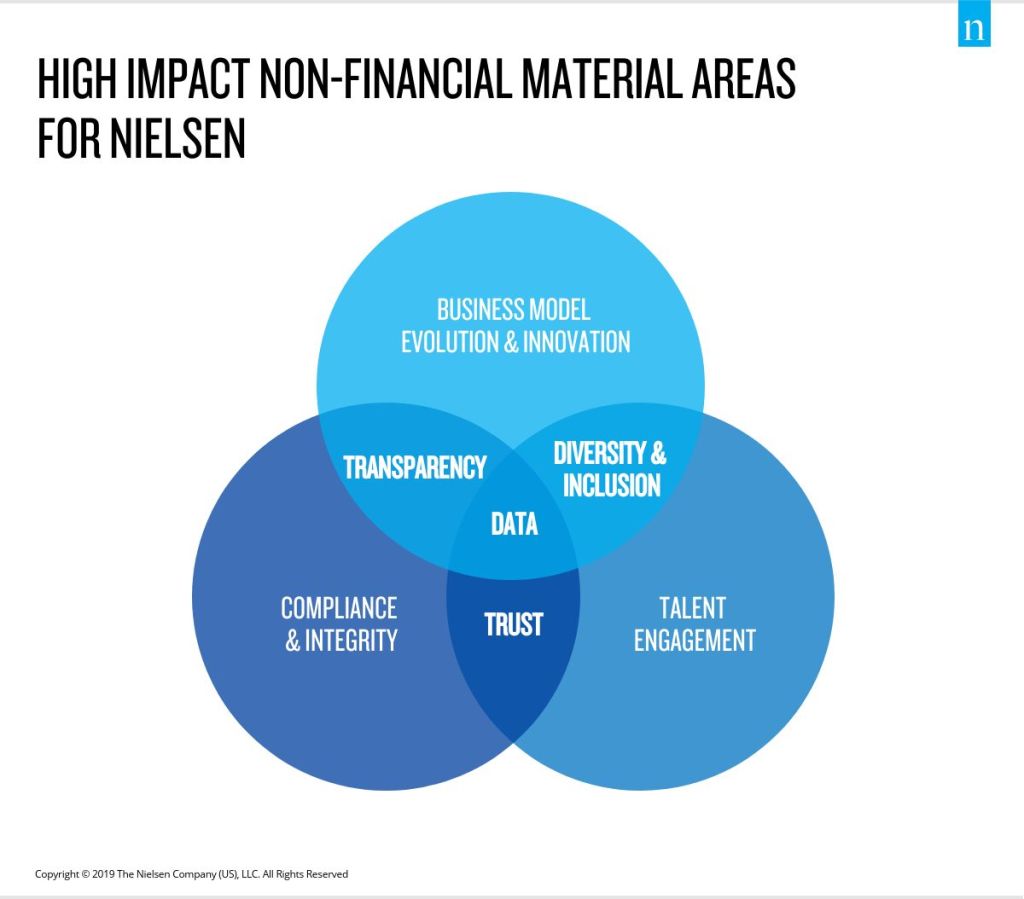
We’ve decided to use a new visual format to distill our priority issue areas for this assessment, as we feel this more appropriately conveys the overlapping and dynamic interactions among our most material issue areas. Rather than the traditional horizontal/vertical axes we’ve used in previous years, we chose instead to use a Venn diagram format to show how these key strategic areas are inherently interconnected and interdependent. Much has changed in our business and operating environment since we published our last assessment in 2017. Shifting market and industry dynamics, increased pressure on our clients’ business models, new and emerging data privacy regulations, and the rapid pace of technological innovation are some of the key factors that we’ve highlighted with our stakeholders as forces of change for our business. While change creates opportunities for evolution, we also recognize the enduring importance of foundational elements of our brand—integrity, trust, transparency, and quality data representative of all consumer populations—aligned with the key areas that came out of this most recent assessment.
Although this graphic does not include the traditional axes of “importance to stakeholders” and “importance to society,” we have applied these fundamental considerations to our analysis and issue prioritization per the Global Reporting Initiative (GRI) Sustainability Reporting Standards. Each issue area contains a myriad of nuanced topics that were specifically cited by our stakeholders, which we recognize as critical for Nielsen to monitor and lead on as we seek to create economic, social and environmental value within and beyond our business, both today and over the long term. We have included definitions for each issue area below to reflect our stakeholders’ feedback and to clarify their unique meaning in the context of our business.
While the most material topic areas highlighted in this narrative are those that ranked highest among the hundreds of inputs we received from our stakeholders, all should be considered important. Topics at the center of the diagram—“Data,” “Trust,” “Transparency,” and “Diversity & Inclusion”—were recognized across stakeholder groups as the foundation on which all of the other issues are based.
At the center, “Data” was most prominently and frequently cited by all stakeholder groups. Data is at the core of our business, and it is fundamental to how we create value across all the other issue areas. Given the nature of our business across more than 90 years, the central importance of data is no surprise. The data we collect, analyze and share with the clients and industries we support each day is the lifeblood of our business. Our clients expect our data to be unbiased, accurate, trustworthy, and collected according to the highest standards of privacy, security, and integrity so they can rely on our insights for their important business decisions. Our shareholders expect us to continue to adapt our use of innovative new technology to the rapidly-changing end-markets in which we work. Our data must also represent all consumers, and we are similarly focused on ensuring that our own workforce represents the communities we seek to measure in order to harness the power of diversity to drive better business outcomes. We also recognize the unique opportunity for data to help communities and nonprofits more effectively deliver on their missions; we seek to contribute to these efforts through our Data for Good initiatives.
많은 이해관계자에게 특정 주제는 성공적이고 지속 가능한 기업이 책임감 있게 운영하기 위한 기본적인 '테이블 스테이크'로 간주됩니다. 닐슨의 경우 이러한 주제에는 다음이 포함되지만 이에 국한되지 않습니다:
- 장기적으로 경제 성과와 성장을 유지합니다;
- Addressing climate change-related issues that impact our global footprint;
- Mitigating any negative ethical, social or environmental impacts that flow through our end-to-end business and supply chain; and
- 특히 긍정적인 사회적 영향을 미치는 데이터 포 굿 프로젝트를 통해 직원 자원봉사와 현물 기부를 통해 지역사회와 소통하고 고유한 인사이트를 제공합니다.
주요 이슈 영역 정의
벤 다이어그램 형식은 모든 중요한 주제들이 어떻게 상호 보완적이고 상호 의존적인지 보여줍니다. 예를 들어, 우리는 정직하게 행동하고 규정을 준수하며 이해관계자와 투명하게 소통함으로써 데이터에 대한 신뢰를 구축하고 유지합니다. 다양성과 포용성은 인재 유지, 유치 및 참여에 대한 우리의 추진력을 뒷받침하며, 궁극적으로 비즈니스 모델이 지역과 문화의 모든 소비자를 반영하도록 지속적으로 발전하는 데 도움이 됩니다. 투명성은 고객과 주주에게 비즈니스 모델(및 우리가 제공하는 데이터)이 건전하며 데이터 수집과 사용에 영향을 미치는 현행 및 새로운 규정을 준수하고 있다는 확신을 줍니다. 이러한 우선순위 영역 간의 내재적인 상호 연관성을 고려할 때, 이들 모두는 똑같이 중요하고 미래 성장에 필수적입니다.
그래픽에서 볼 수 있듯이 이해관계자들은 다음과 같은 비재무적 중요 주제 영역을 우선적으로 파악하는 데 도움을 주었습니다:
데이터
For close to a century, Nielsen has provided data and analytics based on scientific rigor and cutting-edge innovation, continually developing new ways to answer the most important questions facing the media, advertising, retail and fast-moving consumer goods industries. Since data powers Nielsen’s business, it must be of the highest quality: consistent, reliable, and representative of all consumers and channels. The business of data creates responsibilities—a responsibility to protect the consumer, a responsibility to protect the marketing ecosystem, and a responsibility to manage it all with integrity and transparency.
Clients, in particular, expressed interest in how Nielsen ensures that the consumers who provide information to us are representative of a broad range of perspectives, with a special focus on multicultural consumers. On the analytics side, they expect transparency on how we confirm that our insights are unbiased, and that consumers’ privacy is protected through our approach to privacy by design. All stakeholder groups emphasized the importance of protecting the confidentiality of the data and information we collect, and utilizing the latest technology and practices to secure it. We will continue to invest in wide-ranging data privacy, security and integrity safeguards to ensure quality and security are never compromised.
Additionally, stakeholders across the board see continued opportunities for Nielsen’s data to be used for societal and environmental good. To deliver on this, we plan to continue to focus on Data for Good projects where we can make a unique impact through our data, insights, and capabilities, as part of our $10 million annual commitment to pro bono work and our overarching Nielsen Cares volunteer platform.
We believe that our commitment to high-quality, science-backed data is an essential service to the marketplace. The ability to provide useful data, independent of bias towards buyer or seller, will only become more crucial. We also anticipate our ability to make a positive social impact will grow as we continue to work with key nonprofits across our priority cause areas.
신뢰
Facebook의 사명은 전 세계 소비자와 시장에 대한 가장 완전하고 신뢰할 수 있는 시각을 제공하는 것입니다. 소비자가 기꺼이 정보를 공유하려면 당사를 신뢰할 수 있어야 합니다. 당사는 모든 개인 및 기밀 데이터를 비공개로 유지하겠다는 약속을 진지하게 받아들입니다.
신뢰는 닐슨의 모든 업무를 뒷받침하며, 특히 변화하는 소비자 기대치와 규제 환경이 모든 기업의 소비자 정보 수집, 사용 및 판매 능력에 영향을 미치는 상황에서 사회적 라이선스 운영에 있어 매우 중요한 요소로 남아 있습니다. 우리가 운영, 제품, 인력 전반에 걸쳐 구축해 왔고 앞으로도 유지해야 하는 신뢰의 토대는 여전히 핵심적인 경쟁 차별화 요소입니다. 우리는 고객이 광고, 소비재, 미디어 등의 리소스를 활용하고 시장을 형성하기 위해 인사이트를 활용할 때 고객에게 제공하는 데이터가 대표성을 갖고 정확하며 자체 예측 분석에 유용하도록 보장하는 것이 중요한 역할을 한다는 것을 잘 알고 있습니다.
As it is critical to providing independent measurement services for the industries we support, trust is also a key aspect of our talent engagement and retention strategy. Our employees are especially interested in the future evolution of our business as it aligns with their own unique opportunities for career growth. We’re committed to openly sharing new opportunities for learning and development as we seek new ways for our associates to be engaged and grow in their careers alongside our company’s continued evolution.
Transparency
Transparency is key to our ability to showcase the differentiating value of our data, and to share our progress on how we innovate to better meet the imperatives of our world today by connecting with existing and new clients, entering new measurement channels and evolving into a new phase of Nielsen’s overall growth. Specifically, stakeholders expect continued transparency around data collection methodologies and analysis, strategy and future plans, financial reporting, leadership changes and ambitions, and diversity representation. Employees, too, want to continue to be engaged in our long-term growth plans and the resulting opportunities for career development.
Media buyers and advertisers need transparency in order to effectively negotiate and trade in an open marketplace. In using rigorous, independent measurement that provides a source of truth, they want to understand just how effective their efforts are and how they can improve upon them. More clarity ultimately means more trust that they are getting exactly what they paid for. The consumers who provide this data—with every click, every like, and every transaction—also want to know that they are protected. Consumers are more aware and concerned about how data about them is being captured and used today than ever before.
Our success is dependent on stakeholders’ confidence that our data, business practices, forecasting, and financial reporting are unimpeachable. Our business practices, professional behavior, approach to corporate governance, codes of conduct, Global Responsibility Report, public filings, 인사이트 그리고 뉴스 센터, are all a part of our focus on transparency toward our commitment to build and maintain trust across all of our stakeholder groups.
Diversity & inclusion
Diversity & Inclusion remains critical to our business, in terms of our ability to include all consumers across our measurement solutions, to ensure that our workforce represents the changing demographics around the world, and to enable all associates to perform to their full potential. As artificial intelligence and machine learning evolve and present new use cases for measurement, we recognize the importance of ensuring that these tools are used in a responsible way that is representative of all consumers.
The importance of nurturing a diverse and inclusive workplace touches every aspect of Nielsen’s business. A diverse talent pool creates a more productive environment with a broad range of thoughts and experiences that spurs innovation. Clients expect Nielsen to consistently evolve and deliver to provide new insights about multicultural consumers, audiences and media. We can’t effectively measure these audiences without ensuring that our own workforce also reflects a diversity of viewpoints, backgrounds, and life experiences. Outreach to diverse communities also gives us access to new talent pools and a deeper understanding of multicultural communities as we expand our consumer panels.
또한 모든 공급업체와 비즈니스 파트너가 다문화적 접근 방식을 구현하고 우리가 측정하고자 하는 세상을 반영하기를 기대합니다.
Beyond our own value chain, our recent public position opposing the proposed citizenship question in the 2020 U.S. Census was cited by various stakeholder groups as a welcome example of leadership in support of upholding strong data science principles and representing diverse populations.
Business model evolution & innovation
Business Model Evolution & Innovation reflects the importance of continuing to evolve our approach to measurement and the ways that we deliver our data and services across the industries and clients we support. Our data helps clients around the world understand what’s happening now and what’s happening next; to that end, our measurement capabilities and technology must innovate to stay ahead of the rapid pace of change all companies and industries are experiencing today.
또한 전체 시장에 대한 관점을 제공하고 소비자가 상품을 구매하고 미디어를 소비하는 모든 채널을 측정해야 합니다. 이러한 생태계가 계속해서 빠르게 진화하고 성장함에 따라, 일관되고 비교 가능한 데이터를 제공하는 독립적인 데이터 제공업체로서 닐슨의 입지는 더욱 중요해질 것입니다. 닐슨은 고객과 업계가 공동의 목표를 달성하는 데 도움이 되는 속도에 중점을 두고 개방적이고 민첩한 협업 정신으로 지속적인 혁신을 통해 기술을 지속적으로 개선하고 측정 역량을 확장하기 위해 최선을 다하고 있습니다.
Clients and investors are focused on opportunities for Nielsen to stay ahead of the curve through innovation on the cost-side of our business by growing more efficient and developing streamlined ways to collect and synthesize data in an increasingly complex world. Innovation is key to our ability to succeed, and we recognize the importance of protecting our innovations and intellectual property across our entire footprint. Protecting innovation by promptly seeking patent protection on both the revenue-generating side of the business through new products and services and the cost-side of our business through efficiency-generating processes will remain a hallmark of Nielsen’s innovation strategy.
Nielsen’s innovation imperative encompasses the need to leverage artificial intelligence and machine learning to grow our measurement capabilities in new ways, how we engage with our clients, and how we ensure that all channels, categories and consumers are reflected in our coverage. To more seamlessly deliver for our clients and the industries we support, we’ve simplified our organization into two core platforms: Nielsen Global Media and Nielsen Global Connect.
Our focus on innovation also includes opening up to new clients and new end-users of Nielsen data and services as we become more product- and technology-focused as a company. One of these new opportunities is a focus on the sustainability related intelligence we can provide our clients, particularly in the consumer packaged goods and retail spaces.
인재 참여
Nielsen’s future relies on a skilled and stable talent pool. Ensuring that all Nielsen associates feel engaged and supported throughout their career journeys—regardless of race, gender, background or any of the other factors covered by our global non-discrimination statement—remains critical to our ability to attract, maintain, and grow top talent at our company in order to create and deliver better solutions to the marketplace.
As it is especially critical that our employees remain engaged throughout their time at Nielsen, in recent years we’ve invested in growing employee engagement in new ways across a variety of different dimensions, such as regular employee engagement “pulse checks,” encouraging associates and their managers to connect through regular check-ins, and expanding the capacity of our internal mentoring and leadership development programs. Employee engagement is the emotional and psychological connection our associates feel about their workplace and the work that we do. It’s about belonging, commitment, growth, and teamwork. And ultimately, it helps lead to both individual and business success.
현재 직원들은 고용 안정성, 다양성을 지지하는 문화, 향후 경력 성장 및 승진 기회에 대한 투명성을 중요하게 생각한다고 답했습니다. 직원들은 지속적이고 지속적인 교육과 리더십 개발 기회를 직원 유지 및 참여의 핵심 요소로 꼽았습니다.
닐슨의 인재 전략은 장기적인 비즈니스 전략과 직접적으로 연계되어 있습니다. 즉, 혁신, 기술, 효율성에 초점을 맞추고 고객과 우리가 서비스를 제공하는 시장이 보다 효율적으로 운영될 수 있도록 지원한다는 목적을 지속적으로 달성하기 위한 조직 혁신이 인재 개발 및 전략적 인력 계획의 원동력입니다.
Compliance & integrity
Compliance & Integrity complements our cross-cutting focus on trust and transparency. This includes our internal engagement with employees on the need to protect Nielsen’s brand and reputation; the way we engage with our panelists and the consumers we measure; the protections we maintain in our relationships with third-party partners and suppliers; and the end-deliverables we share with our clients. Integrity encompasses good governance, regulatory compliance, and responsible business practices.
As an independent data and measurement company, our clients—and the industries we support—depend on us to be an unbiased arbiter. To serve as a source of truth, integrity must be part of the foundation of all that we do at Nielsen. Maintaining such a culture helps protect the integrity of our data across the clients and markets we serve around the globe, builds a better workplace where employees feel respected and engaged, and increases our stakeholders’ trust in our business and brand. This connection between a strong culture of integrity and increased trust has been critical to our ability to foster a supportive work environment, effectively engage with consumers, provide cutting-edge measurement services, and ultimately to help our clients and markets grow.
전 세계적으로 데이터 개인정보 보호, 사이버 보안 공개 요건 및 규정이 진화함에 따라 규정 준수 환경이 더욱 복잡해지고 있습니다. 이러한 중요한 분야에 지속적으로 투자하여 이러한 요건을 충족하고 이를 뛰어넘을 수 있도록 노력할 것입니다.
