Berhentilah sejenak dan pikirkan bagaimana Anda mengonsumsi media dalam keseharian Anda. Anda mungkin mulai dengan mendengarkan radio atau podcast selama perjalanan atau memeriksa notifikasi berita di aplikasi seluler, menelusuri feed sosial, streaming musik saat bekerja, menonton acara favorit di TV di malam hari, dan bahkan mungkin melirik berbagai papan iklan saat mengemudi dalam perjalanan pulang kerja. Tanpa disadari, Anda mungkin berinteraksi dengan media puluhan kali dalam satu hari. Kalikan saja dengan miliaran, dan Anda mulai memahami keragaman yang sangat besar tentang bagaimana orang berinteraksi dengan konten.
For brands and marketers, this daily reality presents a significant challenge—where is the audience, really? Audiences aren’t just consuming content in one familiar place anymore; their attention is splintered across countless platforms. For example, you might still tune into your favorite show when it airs on TV, you could also be streaming it on demand later, catching up on clips on social media, or discussing it in a dedicated online community. Accurately navigating this complex landscape demands a fundamental understanding of what media fragmentation is to create strategies that grab audiences’ attention no matter where they’re watching.
Apa yang dimaksud dengan fragmentasi media?
Fragmentasi media mengacu pada proliferasi saluran dan platform media. Hal ini menyebabkan audiens semakin terpecah dan tersebar di berbagai macam saluran media, bukan terkonsentrasi pada beberapa saluran media yang dominan. Sekitar satu dekade yang lalu, beberapa outlet dominan seperti jaringan TV besar atau surat kabar menjangkau audiens yang sangat besar. Saat ini, ledakan platform digital, layanan streaming, media sosial, dan pembuat konten khusus telah memperluas jumlah pilihan media yang dapat dinikmati oleh audiens, menciptakan pilihan yang tampaknya tak terbatas.
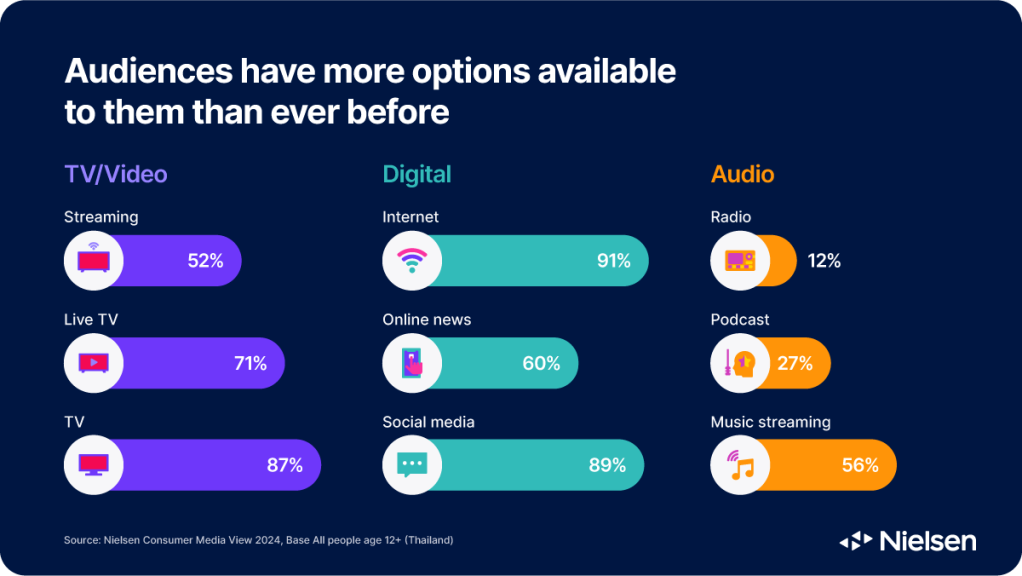
A clear indicator of this shift can be seen in how vast the array of options consumers engage with. Consider Thailand, for example—while a substantial 87% of the population still tunes into traditional TV, this now exists alongside a massive digital ecosystem where 91% are online and 89% are actively engaging with social media. For audio, the options have clearly multiplied, with music streaming services now attracting 56% of listeners, while traditional radio accounts for a smaller 12%.1 Hence, marketers face the challenge of navigating a highly fragmented media environment where reaching and engaging target audiences across a multitude of channels requires increasingly sophisticated strategies and data-driven insights.
Making this even more challenging are some digital platforms and RMNs that can function as walled gardens. These platforms control their own content and user data, meaning much user engagement is locked within their sealed environments. It limits how marketers can access comprehensive data, understand cross-platform customer journeys, and unify their marketing efforts.
Given the explosion of content sources, it’s easy to assume that the splitting of media automatically means the audience is doing the same. This often leads to a common misconception—confusing the fragmentation of media platforms with the actual dispersion of consumer attention.
Apa bedanya dengan fragmentasi audiens?
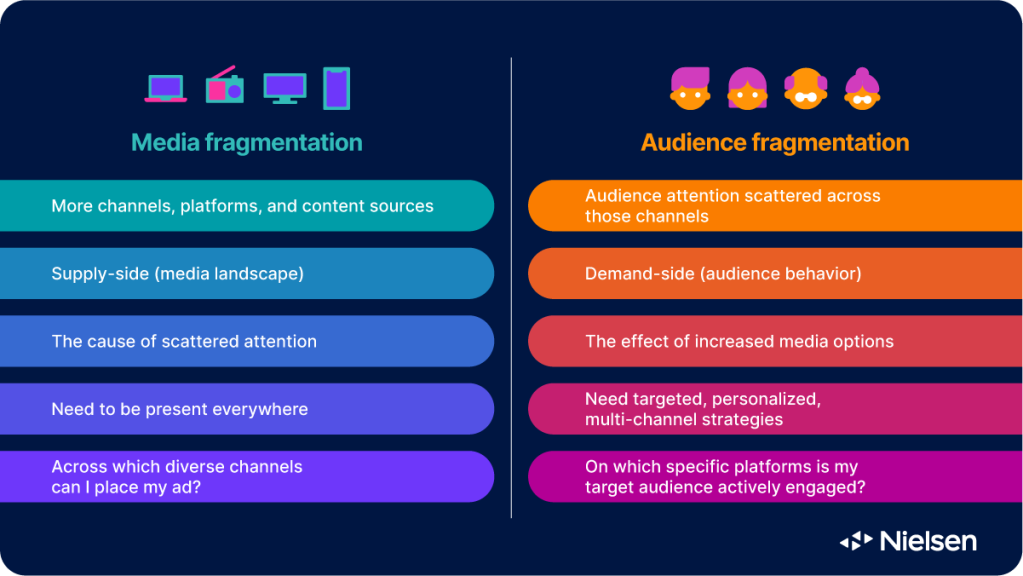
Yes, it is, and understanding the distinction is important to effectively strategize how to reach and engage today’s diverse audiences. While media fragmentation refers to the supply-side proliferation of channels—the sheer, ever-increasing number of media outlets, platforms and content options available—audience fragmentation describes the demand-side behavior of audiences actively scattering their attention across these many options.
The widespread availability of options has led to scattered attention, a reality that is seen in markets around the world. Recent data from Nielsen’s The Gauge report published in May 2025 shows that traditional broadcast and cable programming collectively accounts for 44.2% of time spent with the television set in the U.S. That share is now nearly matched by streaming services, which capture 44.8% of viewing time. Such a shift in media consumption highlights how audience attention is no longer concentrated in a handful of predictable spaces—it now flows across a wide array of platforms, reflecting increasingly fragmented viewing habits.
Strategi untuk menavigasi media dan audiens yang terfragmentasi
With so much media and audience fragmentation, you really need to change how you connect with audiences. The old days of “one-size-fits-all” campaigns, designed for a time when everyone watched the same few TV shows, just don’t work anymore. That broad approach is much less effective now that audiences are spread across countless apps, websites, and platforms. What’s needed is a much more precise and relevant approach.
Untuk menjangkau audiens dalam lingkungan media yang terfragmentasi, Anda perlu memprioritaskan strategi-strategi utama ini:
- Understand your audience deeply: Reliance on a handful of go-to channels is no longer a sufficient strategy. Marketers now need to really dig into what makes their audience tick, like their interests, behaviors, and how they actually use different platforms. Such granular insights enable the creation of audience segments based on genuine engagement patterns and demonstrated preferences, moving beyond superficial categories.
- Integrate multi-channel approach: Brands can elevate their potential by strategically integrating a multi-channel approach. Marketers need to activate diverse touchpoints—like niche online communities, new streaming services, podcasts, and traditional media to ensure they’re present precisely where audiences are engaging.
- Personalize content at scale: The ability to use data and technology to deliver customized content to individuals has shifted from a competitive advantage to a fundamental requirement. Going beyond basic demographic targeting, leveraging past interactions, stated preferences, and real-time actions delivers messages that are inherently more relevant and less intrusive, thereby enhancing the user experience and boosting campaign efficacy.
- Optimize content for platform native experiences: Delivering messages that intrinsically align with each platform’s unique format and the user’s mindset within that environment is important for impact. A concise, visually compelling video ad might thrive on fast-paced social feeds due to its immediate nature, while more in-depth, informational content finds its audience on specialized blogs or within targeted email newsletters where longer engagement is expected. Authenticity to the platform drives receptivity and better results, leading to more effective marketing decisions.
Memastikan efektivitas strategi dengan wawasan lintas platform
Perhatian audiens tersebar di berbagai titik kontak yang tak terhitung jumlahnya, sehingga mengukur keterlibatan dan efektivitas kampanye secara holistik menjadi sangat penting. Mengandalkan hanya pada angka-angka dari masing-masing platform akan menciptakan gambaran yang terkotak-kotak dan tidak lengkap tentang perjalanan audiens, sehingga mustahil untuk benar-benar memahami ROI Anda atau meningkatkan strategi di masa depan.
Nielsen ONE provides a deduplicated and unified view of how audiences engage across all media channels—digital, traditional linear TV, and new platforms. It empowers marketers to understand how different touchpoints contribute to plan, optimize, and evaluate their campaigns with unmatched clarity, taking out the guesswork and allowing for smarter decisions.
Catatan:
1 Nielsen Consumer Media View 2024, Base All people age 12+
Nielsen’s Need to Know reviews the fundamentals of audience measurement and demystifies the media industry’s hottest topics. Read every article here.