Bagaimana pengukuran digital dibandingkan dengan pengukuran TV?
In a lot of ways, it’s similar: It involves panels, big data and technology to capture what people are doing online and who they are. As with TV, publishers use measurement to gauge the popularity of their content and value their ad inventory, and advertisers use it to verify that their campaigns are running and reaching their intended audience at the right frequency1.
Meskipun prinsip-prinsip dasar dan tujuan akhir pengukuran TV dan digital serupa, alat, proses, dan ekosistem yang terlibat sangat berbeda.
Mari selami lebih dalam untuk memahami nuansa cara mengukur audiens dan kampanye digital.
Apa yang kami maksud dengan 'pengukuran digital'?
At the most basic level, digital measurement means monitoring a user’s exposure to ads and content delivered over the internet. When we talk about digital measurement in the media industry, we generally focus on two dominant digital experiences: walled gardens and the open web.2
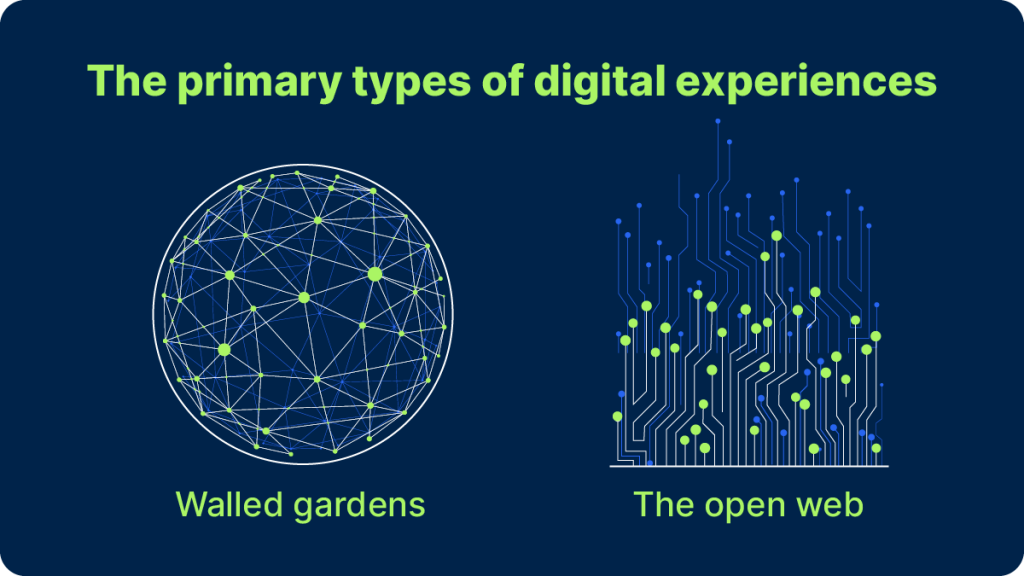
Perbedaan utama di antara keduanya adalah walled garden membatasi akses ke data pihak pertama mereka - Anda tahu, seperti taman yang terkunci di balik tembok - dan web terbuka tidak. Situs media sosial adalah contoh dari walled garden, sedangkan situs dan aplikasi seperti Weather.com, Words With Friends, dan CNN adalah bagian dari web terbuka.
Ini adalah perbedaan yang penting untuk tujuan pengukuran: Secara teknis, walled garden seharusnya memiliki gambaran yang cukup jelas tentang siapa yang mengakses konten dan melihat iklan di platformnya. Tetapi jika perusahaan lain ingin mengukur konsumsi iklan atau konten mereka di dalam walled garden ini, umumnya, mereka harus membangun integrasi khusus yang sesuai dengan peraturan privasi.
Meskipun situs web di web terbuka dapat memiliki data pihak pertama yang kuat dan terautentikasi, hal itu tidak selalu diberikan. Dalam kasus tersebut, situs web umum sering kali mengandalkan ID proxy dan solusi adtech lainnya untuk mengidentifikasi, menargetkan, dan mengukur pengguna.
Tantangan industri saat ini
On the open web, the ongoing deprecation of third-party cookies and device IDs is making it more difficult to identify users and is forcing stakeholders to rethink their measurement approach. Apple’s decision in 2021 to change default app tracking permissions (from opt-out to opt-in) wiped out three-fourths of IDFAs (Apple’s mobile ad IDs) from consideration. And Google is scheduled to phase out third-party cookies in the second half of 2024, the final blow to an ID system that held up for the most part, but was always an imperfect solution. Cookies aren’t people, after all.
For walled gardens, the practice of sharing granular subscriber data with outside parties is largely a thing of the past, even for anonymized measurement purposes. To comply with major data global privacy regulations, walled gardens are now sharing activity data with advertisers and measurement companies in aggregate form, if they’re sharing it at all.
Hal tersebut merupakan tantangan serius untuk pengukuran yang telah memaksa industri untuk mencari pengidentifikasi, sinyal, dan atribut konsumen di tempat lain. Dan semuanya dimulai dengan sebuah kesan.
Apa sebenarnya 'impresi' digital itu?
Sebelum kita membahas secara detail, seperti apa proses pengukuran digital modern, mari kita jelaskan apa itu impresi.
Tayangan mengukur berapa kali iklan atau konten dikirimkan ke perangkat digital. Meskipun tayangan memberi Anda volume total paparan terhadap iklan atau konten Anda, namun tayangan tidak mengukur berapa banyak orang yang benar-benar melihatnya. (Itu adalah jangkauan.) Jadi, misalnya, jika lima orang melihat iklan LinkedIn Anda dua kali, berarti tayangan kampanye Anda adalah 10.
Pedoman penayangan media digital saat ini untuk memenuhi syarat tayangan menetapkan bahwa sebuah iklan harus memiliki setidaknya 50% fokus pada layar pengguna - tidak tersembunyi di balik jendela lain, misalnya, atau diputar di latar belakang - setidaknya selama 1 detik untuk iklan bergambar dan 2 detik berturut-turut untuk iklan video. Waktu tayang dan ambang batas penayangan sekarang memberikan dasar yang kuat bagi pengiklan dan penerbit untuk menetapkan ketentuan transaksi media mereka.
Setelah kita memahami aktivitas digital apa yang kita ukur, mari kita bahas bagaimana kita mengukurnya.
5 langkah utama dalam proses pengukuran digital
Di Nielsen, kami melihat pengukuran digital sebagai sebuah proses lima langkah:
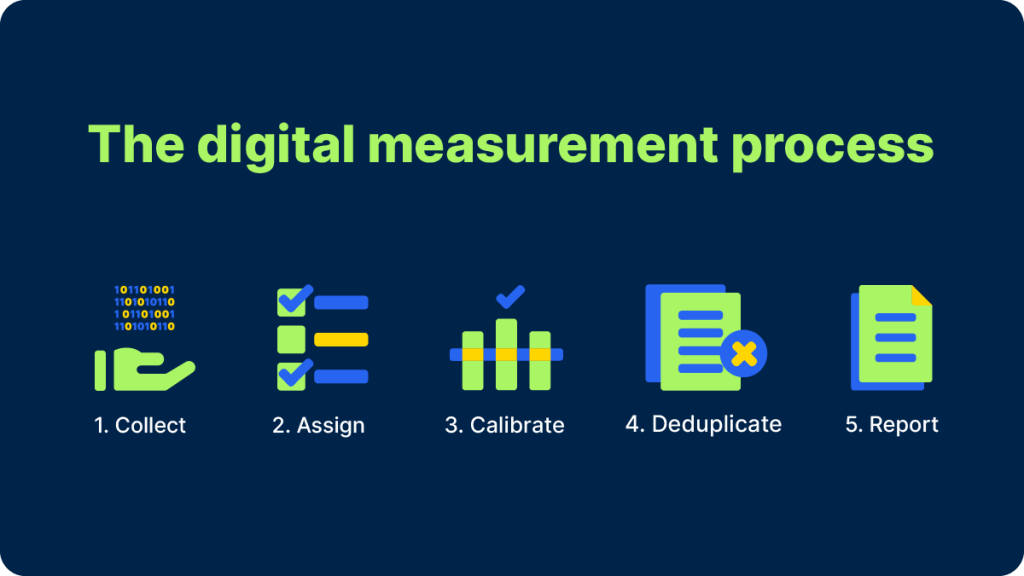
Langkah 1: KUMPULKAN
The first step in the process is to make sure that the content and ads data is all properly captured and identified. For web content, a page URL is an acceptable identifier, but there might be multiple ads on a single url that will need to be uniquely identified. For content measurement, clients’ integrate Nielsen’s SDK3 within their websites or apps. For ads measurement, we either use direct integrations with publishers, or ask advertisers or their agencies to integrate Nielsen tags in their ads when they traffic campaigns. When ads are delivered to the user’s browser or app, those Nielsen tags ping our servers with information about the ad that was delivered along with important meta-data information that enables us to filter out any invalid robotic traffic. Javascript tags, on top of all the campaign data, capture additional signals for measuring second-by-second viewability data (for display and video ads) and audio volume levels (for video ads). This allows us to accurately collect all the impression data.
Langkah 2: TETAPKAN
The next step is to assign those impressions to a person. With the ecosystem changes discussed above, we’re now transitioning to a system where cookies are replaced with alternate identifiers and first-party data provided by clients—such as hashed email addresses, Unified ID 2.0 or self-reported demographic labels—and verified against our own growing ID graph. The goal is to get as close as possible to the demographic profile of the person who was exposed to the content or ad, and if that’s not possible, at least attach some useful information about their behavior and interests.
Langkah 3: KALIBRASI
Then, you need to calibrate your data for demographic accuracy. It’s important to acknowledge that even the best demo assignment process in the world will still return many cases where the user couldn’t be identified, and those misses can’t be assumed to be randomly distributed across all demographic groups. This may lead an advertiser to draw erroneous conclusions about the impact of their campaign. A panel can be used as a source of truth to calibrate census-level impressions. At Nielsen, we maintain digital and participant panels of 725,000 for exactly that purpose. Some are equipped with a computer meter, others with a mobile meter to measure their app and web usage on smartphones and tablets. And we make sure we have accurate demographic and profiling data for everyone in the panel
Langkah 4: DEDUPLIKASI
Next, you must ensure your campaign reach isn’t inflated across devices . Over the course of a campaign, people are typically exposed to it many times, especially when that campaign is running on multiple walled gardens and on the open web. Multiple exposures are generally a good thing—it takes a few impressions to make an impression—but advertisers are rightfully very mindful of ad waste4 and putting off consumers with repetitive ads. Deduplicating reach—that is, ensuring the same viewer isn’t counted multiple times—and calculating a campaign’s true frequency are critical steps in the measurement process.
Langkah 5: LAPORAN
Finally, you need to monitor performance. Everything above needs to happen on a continuous basis, and actionable reports need to be available as quickly as possible to give marketers the insights they need to reallocate funds to their most effective channels and most receptive audiences while their campaign is still in flight and there’s still time to change course.
Bergerak menuju pengukuran lintas media
Industri pengukuran berada di bawah tekanan besar untuk beradaptasi dengan perubahan besar yang sedang berlangsung dalam ekosistem digital. Pengiklan membutuhkan pandangan yang jelas tentang kinerja kampanye di seluruh perangkat digital, kepercayaan diri dalam hasil, dan alat yang dapat diandalkan untuk mengoptimalkan kampanye mereka dalam penerbangan.
But there’s even more pressure to get digital and TV impressions on a level playing field. This is an ongoing effort—what constitutes an impression on linear TV and on digital platforms aren’t the same yet—but thanks to the development of a common ID system and launch of Nielsen ONE, we’re already helping marketers deduplicate reach and frequency across select digital and linear platforms in key markets around the world.
At Nielsen, we’ve also recently launched ‘Always On’ digital measurement with proactive partners like YouTube to emulate the way that linear measurement is done and help marketers turn on digital measurement capabilities on a continuous basis, rather than campaign-by-campaign.
Masih banyak pekerjaan yang harus dilakukan agar pengukuran lintas media secara penuh dapat menjadi kenyataan di industri kami, namun dengan prioritas, alat, dan proses yang tepat, kami sudah lebih dekat dari sebelumnya.
Nielsen’s Need to Know reviews the fundamentals of audience measurement and demystifies the media industry’s hottest topics. Read every article here.
Sumber
1For an overview of TV measurement, read Need to Know: How Are TV Audiences Measured?
2Connected-TV platforms and retail media networks share many characteristics with both walled gardens and the open web. Stay tuned for a future Need to Know article on those fast-growing media channels.
3The Nielsen software development kit (SDK) is one of multiple framework SDKs that Nielsen provides to measure both static and video content across platforms.
4Nielsen’s Digital Ad Ratings estimate that 37% of digital ad spend is currently wasted on impressions that are off-target, out-of-view or SIVT.