Sepertinya dunia tidak pernah begitu bergantung pada konektivitas seperti yang terjadi dalam satu tahun terakhir ini. Dengan sebagian besar penduduk dunia menghabiskan lebih banyak waktu di rumah, teknologi telah menjadi jalur kehidupan untuk segala hal, mulai dari perdagangan, pertemuan sosial, hingga hiburan terbaru. Banyak yang telah ditulis tentang bidang-bidang ini, tetapi mengingat bahwa konektivitas memberikan jutaan orang Amerika kemampuan untuk bekerja dari rumah dan memberikan akses ke sekolah virtual kepada anak-anak yang tak terhitung jumlahnya di seluruh negeri, maka dapat dikatakan bahwa virtual adalah IRL yang baru.
That has inspired many Americans to think about where they want to live. Especially if a physical office location is no longer a consideration, the idea of relocation becomes a real option, particularly for those seeking to escape the density of heavily populated urban areas. Many consumers sought temporary solace away from big cities early on, but the prolonged duration of the COVID-19 pandemic has metro-dwellers thinking about more permanent moves, especially as many work-from-home and remote schooling arrangements remain intact.
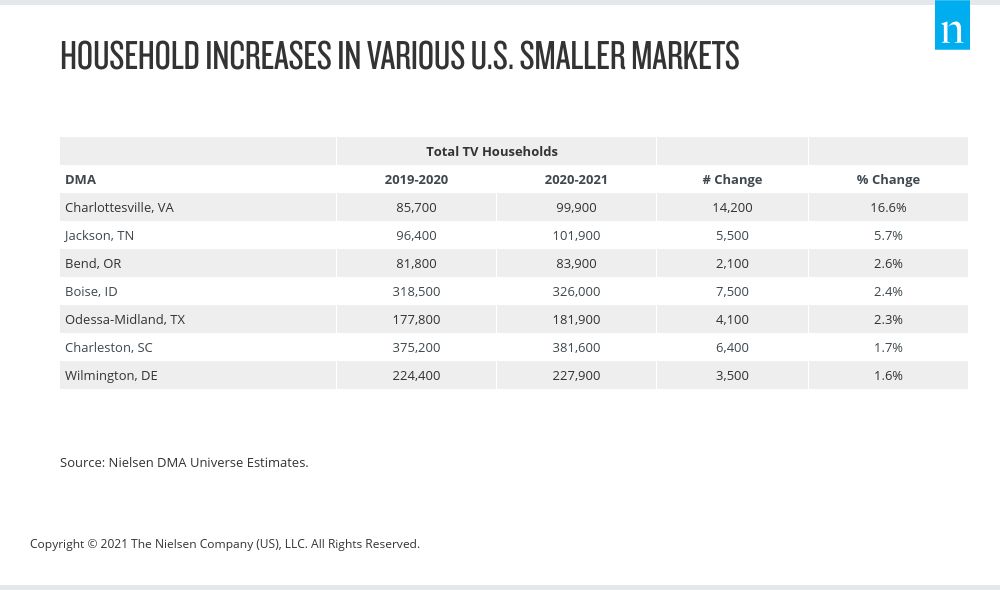
The prospect of moving could have long-lasting implications for the distribution of the U.S. population. According to recent Oliver Wyman research, one in five urban dwellers is planning to move or considering a move because of the pandemic. And we’re already starting to see the shift. In looking at Nielsen’s year-over-year U.S. household data, we can see increases in an array of smaller-sized designated market areas (DMAs). Many of the increases represent changes of less than 2%, but a handful have been more significant, with the Charlottesville, Va., DMA registering a 16.6% increase in households between the 2019-2020 and 2020-2021 universe estimate periods.
Tren ini penting bagi merek dan pengiklan yang ingin tetap berhubungan dengan konsumen karena kebiasaan mereka-dan habitat mereka-bergeser.
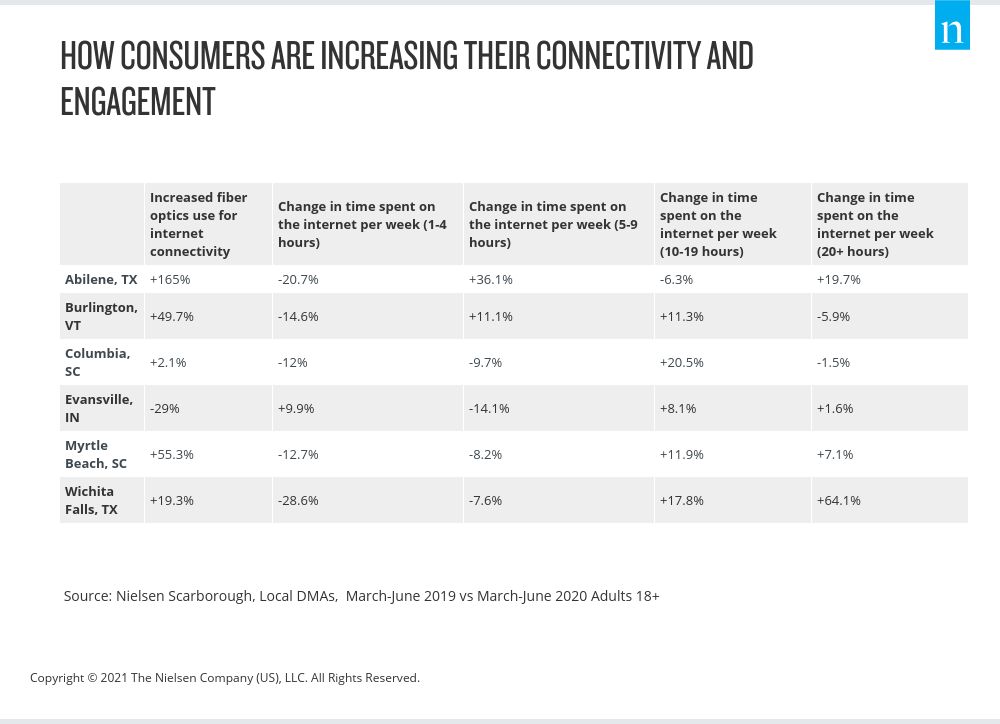
Importantly, many of the country’s lesser-populated DMAs present a valuable opportunity given how digitally engaged their residents are. Whether they’re in cities in Texas, South Carolina, Indiana, Florida or Colorado, consumers in these markets are spending more time connected online. In Abilene, Texas, for example, which is just over 200 miles away from Austin, household use of fiber optics connectivity had increased 165% according to the survey data from Nielsen Scarborough. That connectivity has facilitated a 36% increase in usage of five to nine hours online per week, as well as nearly a 20% increase in usage of 20 hours or more online. In some DMAs, such as Myrtle Beach, S.C., and Wichita Falls, Texas, we’re seeing decreases in internet usage across shorter periods of time and increases in usage across longer periods of time.
Selain menghabiskan lebih banyak waktu untuk menggunakan internet, konsumen di banyak daerah dengan populasi yang lebih sedikit mengikuti tren nasional untuk beralih ke ranah streaming dan video on demand yang sedang berkembang. Pada kuartal kedua tahun 2020, konsumen AS menghabiskan rata-rata 1 jam 14 menit setiap hari dengan perangkat yang terhubung ke internet, naik dari hanya 50 menit setahun yang lalu. Sebagian besar waktu tersebut dihabiskan untuk menonton konten streaming, yang menurut pengukuran Nielsen TV, menyumbang 23% dari total waktu menonton TV di rumah-rumah yang mendukung streaming pada bulan Desember 2020. Dan sementara lima besar platform streaming video on demand (SVOD) (Netflix, Amazon Prime, Disney+, Hulu, dan YouTube) menyumbang 53% dari menit streaming setiap minggu, berbagai penyedia dalam kategori "lainnya" sekarang mengumpulkan 47% lainnya.
Multichannel video programming distributors (MVPDs; traditional cable companies that augment traditional delivery with a streaming app) and virtual MVPDs are newer to the streaming landscape, but accounted for 36% of the “other” category as of July 2020. They’re also gaining in popularity across many of the country’s lesser-populated DMAs, including Abilene, Burlington and Evansville. In Abilene, for example, Nielsen Scarborough survey data shows that consumers’ past 30-day usage of Sling TV (a subscription-based vMVPD) was almost 235% higher than during the previous survey period. Consumers in the Burlington, Vt.-Plattsburgh, N.Y. DMA report an increase of nearly 102%. Comparatively, consumers in Abilene and Burlington report increased or flat usage of the more traditional SVOD services, but the reported increases were notably lower than those reported for vMVPD usage.
Importantly, despite the growing streaming options available to consumers (including free ad-supported offerings), many are focused on premium offerings. For example, according to Nielsen Scarborough data, consumers in Evansville report more than a 5% decrease in using an internet-connected device or app to watch free TV programs. In Myrtle Beach, consumers report a decrease of 26%. In combination with increased stated usage around paid video options, it’s clear that consumers in these DMAs are gravitating toward what interests them rather than what’s free. This speaks volumes about the value of quality content—even as the market is seeing an array of free, ad-supported options come to market. And when you consider that adults 18 and older were spending an average of almost 11-and-a-half hours with media each day as of June 2020, knowing which platforms and programs they’re engaging with—and the markets where they’re engaging—couldn’t be more important.