In the U.S., the annual Upfront (and Newfront) events put TV media in the center spotlight. This year, we’re diving into the Nielsen data to help the industry understand the trends that are shaping the way we watch.
1. Linear TV still represents the majority of the ad-supported opportunity.
Looking at our most recent classic Gauge report–which represents total use of the television set–you can see that linear TV and streaming are rather close to one another in terms of share. Broadcast and cable combined represent 44.5% of time spent, and streaming represents 43.8%.
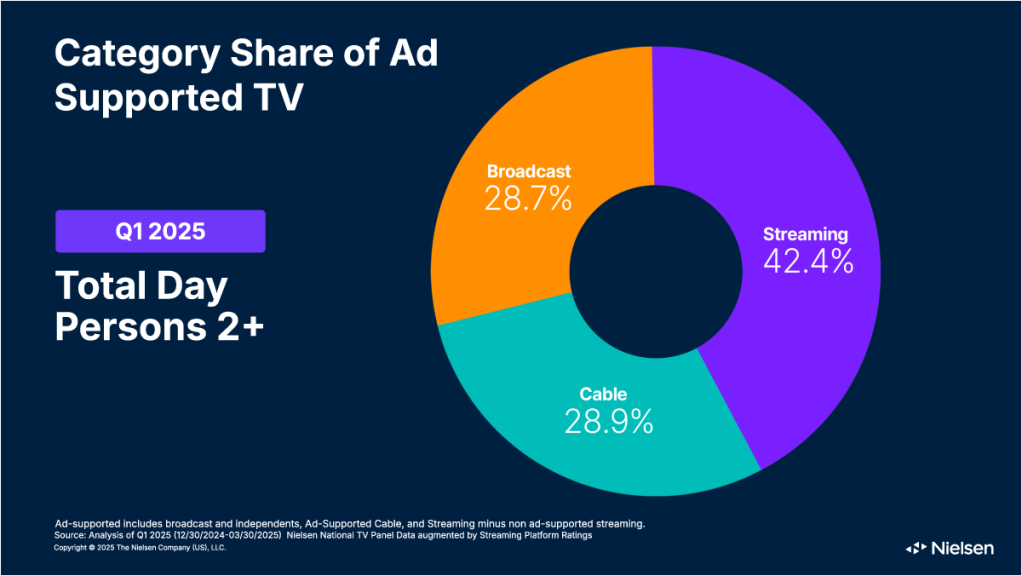
However, when we peel back the onion a bit more and look strictly at ad-supported viewing, we can see that gap gets significantly wider. In our recently released Ad Supported Gauge, broadcast and cable combined account for 57.6% of time spent, while streaming is at 42.4%. So, while streaming certainly continues to gain ground, when it comes to the opportunity to see ads, linear still has a significant lead.
2. TV’s multiplatform opportunity has come into focus.
Streaming hat die Fernsehlandschaft in den letzten 10 Jahren nachhaltig verändert, und es ist leicht, die Dinge als einen Wettbewerb zwischen der Streaming-Welt und der Welt des Rundfunk- und Kabelfernsehens zu betrachten. Wenn man sich jedoch die aktuellen Zuschauerzahlen ansieht, stellt sich heraus, dass es sich eher um ein "Ja, und"-Gespräch handelt (um einen Ausdruck aus der Welt der Improvisationskomik zu verwenden).
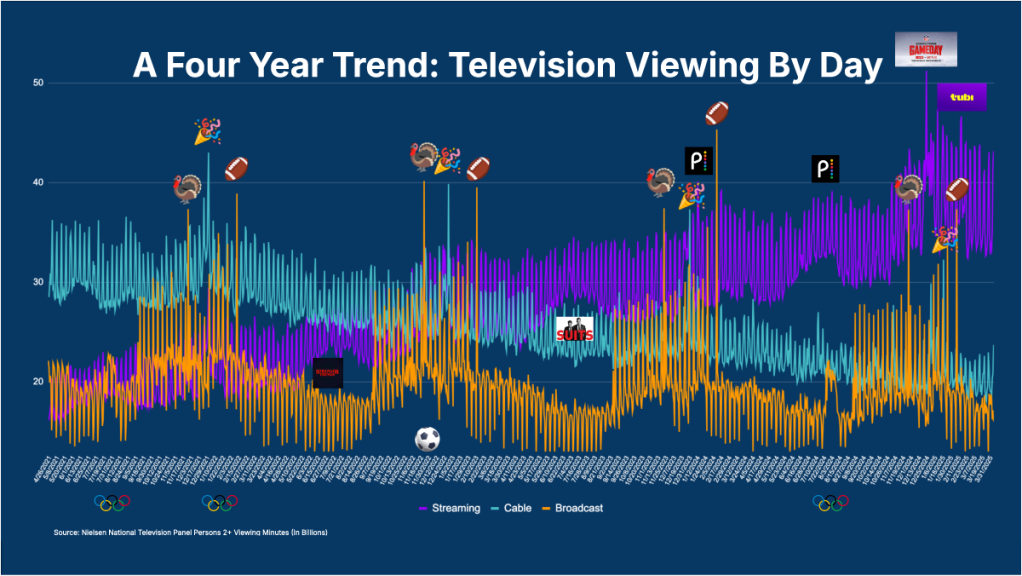
Certainly there are moments when each platform shines: Thanksgiving football and the Super Bowl on broadcast; New Year’s college football on cable; Fremde Dinge und Suits on Netflix. However, we’ve also seen how the different platforms can work together to really meet different viewers where they are. The 2024 Summer Games are one clear cut example: NBCU’s Peacock delivered live streams and highlights by sport throughout the competition, but NBC’s primetime coverage still saw substantial increases compared to the prior Summer Olympics. This year’s Super Bowl is another: Tubi was able to draw a different but complementary audience relative to FOX’s broadcast.
There are more subtle examples as well. The first season of CBS’s Fire Country launched on Netflix just before the third season premiered on broadcast, and likely reached viewers who hadn’t seen the show previously. Then, when the third season opener landed on Paramount+, it saw a 55% bump in viewership compared to the second season premiere.
Und selbst wenn wir die TV-Aktivitäten eines einzelnen Unternehmens betrachten und die Einschaltquoten nach Altersdemografie untersuchen, können wir erkennen, wo es Möglichkeiten gibt, innerhalb eines einzigen Portfolios unterschiedliche Zielgruppen zu erreichen. Disney ist ein Beispiel für diese Dynamik; NBCUniversal und Paramount wären zwei weitere.
3. Streaming ist zunehmend wettbewerbsfähig geworden - es gibt mehr Hits auf mehr Plattformen.
Netflix remains a powerhouse in the streaming world, but as other platforms mature and content strategies evolve, we’re seeing a wider range of titles land in our top 10 rankings. Five years ago, Netflix carried eight of the 10 top streaming assets, but this past March, we saw a total of seven different companies score entries on the chart. This creates more opportunities for brands to be part of the cultural conversation.
It’s also important to see this in context as originals that attract a big audience tend to peak quickly whereas multi-season titles with deep libraries (e.g. NCIS, Grey's Anatomy) are critical to hold audiences over time.
4. Sport nimmt einen immer größeren Anteil am linearen Fernsehkonsum ein, sorgt aber auch für große Zahlen beim Streaming.
In the four year daily viewing trend above, you can see the big spikes in viewing on broadcast and cable around major Sportereignisse. But it isn’t just the big moments that are attracting viewers; in fact, sports content has increased its share of viewing on linear TV in each of the last four years. Entertainment content retains the lion’s share, but in 2024, sports approached 20% of total viewing time among adults 25-54. Given how powerful live sports are for both fan engagement and as a promotional platform, it will continue to be a major asset for networks.
All that being said, streamers are certainly part of the sports conversation now, and are seeing it pay dividends. Thursday Night Football on Prime Video averaged over 14 million viewers this past season, and the Christmas Day NFL games on Netflix hit new streaming highs and helped drive total streaming viewership to over 50 billion minutes for the first time on a single day.
5. Mehrsprachige Inhalte und umfangreiche Bibliotheken machen Streaming zu einem großartigen Ort, um unterschiedliche Zielgruppen zu erreichen.
As we’ve noted in our Black und AANHPI Diverse Intelligence Series reports this year, multicultural consumers are essential for brands to connect with. Linear TV certainly still offers options to reach them–for example, broadcast is particularly important for Hispanic homes–but the depth and breadth of streaming options available today allows audiences to really dig in.
Da Netflix und YouTube viele internationale Inhalte anbieten, ist es nicht verwunderlich, dass sie einen bedeutenden Anteil der Sendezeit bei verschiedenen Zuschauern, insbesondere hispanischen und asiatischen Zuschauern, ausmachen. Die beiden Plattformen machen für beide Gruppen etwa ein Drittel der gesamten Fernsehzeit aus.
Im Allgemeinen spiegelt das Streaming die Zusammensetzung des gesamten Fernsehuniversums besser wider als das lineare Fernsehen. Ein Blick auf einzelne Plattformen offenbart jedoch zusätzliche Möglichkeiten. Wir haben bereits Netflix und YouTube erwähnt, aber weitere Beispiele sind der Roku-Kanal und Tubi, die bei schwarzen Zuschauern stark überdurchschnittlich vertreten sind.