TV has changed dramatically in recent years. New devices, distributors, streaming platforms, subscription models, and formats are transforming the industry and empowering viewers. But there’s one thing that hasn’t changed: People love to watch TV together.
It depends on the occasion, of course—what the program is, the time of day, the size of the screen, what room it’s in, the size of the family and whether anyone simply happens to be around. But people get together today to watch the Super Bowl or The Bachelorette for the same reason they got together to watch M*A*S*H or the Apollo 11 moon landing half a century ago: to have someone to share the experience with.
In the lingo of the media industry, that’s known as co-viewing. Let’s examine why it’s so important for measurement companies to get it right.
Wie oft sehen die Menschen gemeinsam fern?
Nielsen beschäftigt sich schon seit langem mit dem Co-Viewing. Unsere historischen Messlösungen waren schon immer personenbasiert, selbst als es nur eine Handvoll großer Fernsehsender gab. Wir hatten also schon immer eine verlässliche Quelle, um das Co-Viewing zu messen. Heute werden 47 %1 des linearen und vernetzten Fernsehens (CTV) in amerikanischen Haushalten von mehr als einer Person gleichzeitig genutzt.
Today, there’s virtually no difference in co-viewing rates between linear TV and CTV, but it wasn’t always the case. Back in 2017, we ran a study with Roku and found a significant gap in co-viewing between linear TV (48%) and OTT (34%). Since then, smart TVs have become more widespread and large screens more affordable. And, increasingly, consumers don’t make the distinctions between linear and streaming or TV and digital. It’s all TV.
But that doesn’t mean that there aren’t any variations and that the same co-viewing factor can be applied across the board. There’s more co-viewing during primetime and on weekends, for sports and children programming, among men, young adults and in houses with more children. It also matters where the TV is located inside the house. Every case is different, and the only way to properly account for co-viewing is to measure it directly or model it separately for every ad impression.
Warum ist es wichtig, ob Menschen gemeinsam fernsehen?
Most brands want to reach people, not households—and certainly not faceless devices. Wholesale ad impressions are nice, but they’re not enough. When they buy media, advertisers and their agencies spend top dollars to reach specific demographic targets (like 18-34 year-old women in Philadelphia, or 55+ in Arizona) or advanced audiences (like EV drivers who buy organic). They need guarantees that their ads are reaching the right people, and measuring co-viewing gets to the heart of that question.
Medienunternehmen ihrerseits müssen wissen, wer ihre Inhalte ansieht, um ihr Publikum zu verstehen, ihr Programm zu optimieren und die Preise für ihr Werbeinventar richtig festzulegen. Wenn eine neue Sendung beispielsweise bei jungen Erwachsenen besonders gut ankommt, können sie neue Staffeln bestellen, ähnlichen Sendungen grünes Licht geben und eine Nischenfangemeinde aufbauen, die sie monetarisieren können, um ihre Abonnentenzahlen zu erhöhen oder Werbekunden zu gewinnen, die diese Zuschauer erreichen wollen.
In der heutigen stark fragmentierten und äußerst wettbewerbsintensiven TV-Landschaft verkaufen Medienunternehmen keine "Tonnage" mehr, und Werbetreibende kaufen keine wahllosen "Augäpfel". Sie alle benötigen Messlösungen, die ihnen helfen, Zuschauer (innerhalb und über verschiedene Geräte hinweg) zu deduplizieren, die zielgerichtete Auslieferung von Werbung zu berechnen, Reichweite und Häufigkeit zu optimieren und wichtige Leistungsindikatoren für Kampagnen zu verbessern (z. B. die Effizienz von Zielgruppen). Ohne Messung auf Personenebene können Sie keines dieser Ziele erreichen.
Wie messen wir bei Nielsen das Co-Viewing?
The most direct way to measure co-viewing is to monitor TV viewership at the individual level. That’s the case with our National TV Panel and top Local TV Markets. In these markets, our panelists “check-in” to the audience. But to add more depth and stability to our audience solutions—and provide more visibility into smaller audiences in smaller TV markets—we’re increasingly relying on big data based on ACR (for smart TVs) return-path data (for cable and satellite providers), or device and context identifiers (for ad impressions). And those technologies only capture viewing information at the household level.
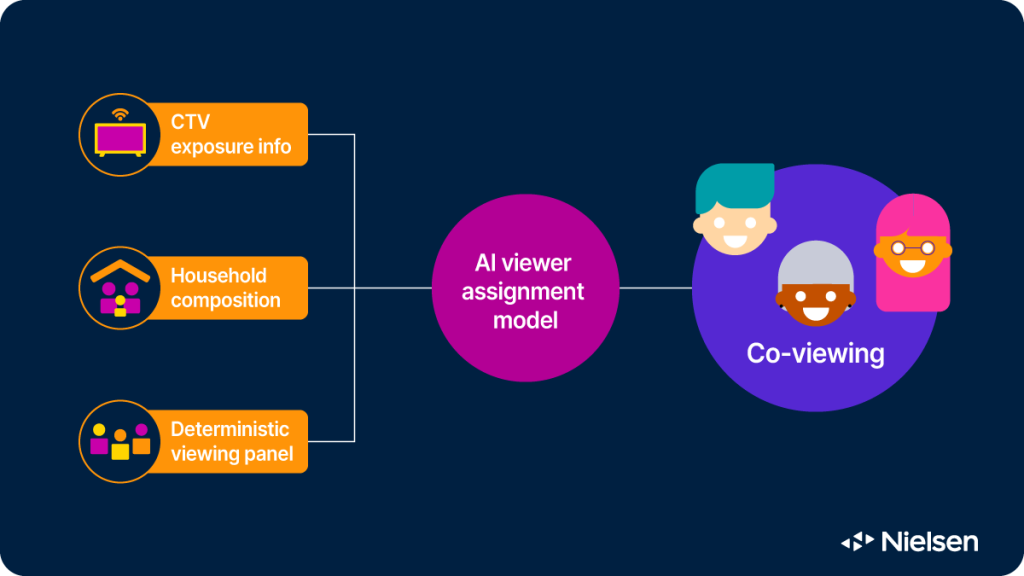
Nielsen is able to determine who is watching thanks to a process called Viewer Assignment that was developed a decade ago and has since been continuously refined. It uses advanced statistical techniques to match faceless viewing data from big data sources (like Roku, Vizio, Hulu, Netflix, YouTube and others) to our persons-level panel data for every possible viewing event and ad impression. The match is based on similarities in viewing behavior (down to the program level) as well as geography, household composition, device type and location inside the house, time of day, day of week, and other key predictors. The model never stops learning, and we’re constantly validating its performance to make sure it’s as close to reality as possible.
Es ist jedoch wichtig zu erkennen, dass ein Prozess wie die panel nicht alle Fälle fehlender Zuschauerdaten ausgleichen kann. Manchmal gibt es keine verlässliche Übereinstimmung mit den Zuschauerdaten, oder die Haushaltszusammensetzung ist nicht ohne weiteres verfügbar. Bei etwa 9 % aller CTV-Daten ist es nach wie vor schwierig, selbst einfache demografische Merkmale wie Alter und Geschlecht der Zuschauer zuzuordnen. In diesen Fällen verlässt sich Nielsen auf robuste Prognosemodelle, um die Zuschauerzuordnung zu ermitteln und zu liefern.
What’s next?
Jüngste methodische Durchbrüche haben uns geholfen, Zuschauereigenschaften viel mehr Werbeplatzierungen zuzuordnen - und damit unsere Fähigkeit, die Reichweite zu messen, erheblich zu verbessern. Unsere Modelle lernen ständig aus den riesigen Datenmengen und Signalen von Nielsen, so dass unsere Vorhersagen über die Zuschauer immer umfassender werden.
Co-Viewing war schon immer ein fester Bestandteil des TV-Erlebnisses, und das wird sich so schnell auch nicht ändern. Stellen Sie sicher, dass es auch ein integraler Bestandteil Ihrer Messstrategie ist.
Nielsen’s Need to Know reviews the fundamentals of audience measurement and demystifies the media industry’s hottest topics. Read every article here.
Anmerkungen
1Nielsen Panel Data