Wenn Sie bei Amazon nach einer Decke mit Waffelmuster, bei Target nach Sommermode oder bei Best Buy nach einem Geschirrspüler suchen, ist die Wahrscheinlichkeit groß, dass die ersten Suchergebnisse, die Sie sehen, gesponserte Anzeigen sind. Möglicherweise wird auch ein Werbebanner oben auf der Seite eingeblendet, und nach ein oder zwei Scrollvorgängen wird ein ansprechendes Video eingeblendet. Das sind die Medien des Einzelhandels: Werbung, die auf Ihre Kauflaune zugeschnitten ist.
Retail media networks are all about seizing the moment, so let’s jump right in.
Was sind Einzelhandelsmediennetzwerke?
According to eMarketer, a retail media network is “an asset owned and operated by a retailer that publishes advertisements, or a third-party publisher with ads that leverage a retailer’s first-party shopper data.”
Einzelhändler sammeln Daten über Ihr Einkaufsverhalten und nutzen sie, um Ihr Einkaufserlebnis zu personalisieren, einschließlich der Werbung, die Sie sehen. Sie können Ihr Einkaufsprofil - und alles, was sie sonst noch über Sie aus Ihren Interaktionen mit ihnen erfahren - nutzen, um die Werbung zu beeinflussen, die Sie in den sozialen Medien, im Fernsehen und im digitalen Radio sehen (oder hören). Darüber hinaus sind die Mediennetzwerke des Einzelhandels in der Lage, Werbeeinblendungen nahtlos mit Verkäufen auf einer Plattform zu verknüpfen, was bisher nicht möglich war.
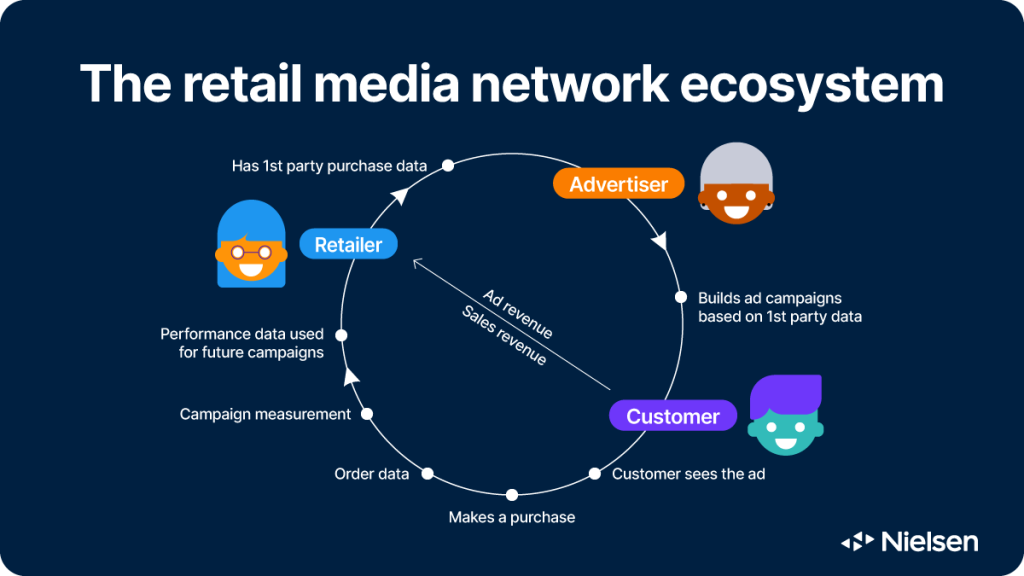
Wie kam es zu den Einzelhandelsmedien?
Für die meisten Branchenbeobachter war die Veröffentlichung von Amazons programmatischer Werbelösung, Amazon Ads Platform (AAP), im Jahr 2012 die Geburtsstunde der Einzelhandelsmedien.
Learning from people’s shopping behavior, presenting them with relevant offers and reaching them at the point of purchase wasn’t exactly a new idea. Direct to consumer (DTC) brands, and brands with loyalty programs before them, had long used first-party shopper data to target consumers. And grocery chains and big box retailers have always featured in-store displays and promotions. But the scale and automation offered by Amazon were unprecedented.
From about $600 million that first year to $45 billion in 2023, the rise of Amazon’s ad business has been meteoric—and that was before the launch of its ad-supported Prime Video tier in early 2024. Over time, its success has drawn hundreds of other retailers into the media business. Walmart, Target, Kroger, Instacart, The Home Depot and others are fueling a sector that’s growing at twice the pace of social media (16.3% vs. 8.7% in 2023, according to the IAB) and is expected to overtake linear TV over the next couple of years.
Warum ist die Begeisterung so groß?
Mediennetzwerke im Einzelhandel sind eine Win-Win-Win-Situation für Einzelhändler, Marken und Verbraucher.
For large retailers, scale and specialized audiences can represent a whole new revenue stream—with much stronger margins than their core retail business to boot. BCG estimates retail media margins in the 70% to 90% range for onsite ads and 20% to 40% for offsite ads, at a time when inflation, supply-chain issues and other macroeconomic conditions are putting intense pressure on retailers’ standard lines of business.
For brands, retail media networks offer a chance to create audiences based on recent shopping behavior and reach those audiences with finely tuned messages at a time when they’re likely to be more receptive to those messages. Relevant ads to the right people and in the right context is a great combination, especially now that third-party cookies and other legacy identifiers are (slowly) being deprecated. And retail media networks aren’t limited to lower-funnel campaigns either. No wonder 70% of global marketers say retail media networks are more important to their 2024 media plan than the previous year.
Auch die Verbraucher gewinnen, denn sie sehen keine Werbung für Schneejacken oder Kreuzfahrten nach Alaska, wenn sie Boardshorts und Schnorchelkurse auf Hawaii kaufen.
Wichtige Überlegungen zum Medienmix
Die Einzelhandelsmedien sind zwar zweifellos ein aufregender neuer Kanal für Werbetreibende, aber Sie sollten nur aus den richtigen Gründen in sie investieren. Ist die Zielgruppe die höheren Kosten wert? Können Sie nicht nur bestehende Kunden, sondern auch attraktive neue Interessenten erreichen? Wie passt er zu Ihrem übrigen Medienmix? Verfügen Sie über konsistente Berichte, um die Leistung mit anderen Einzelhandelsnetzen zu vergleichen?
Die Einzelhandelsmedien sind zweifellos ein aufregender neuer Kanal für Werbetreibende, aber Sie sollten nur aus den richtigen Gründen in sie investieren.
Too many marketers add retail media to their mix out of fear of missing out or out of concern that retailers might retaliate with inferior ‘shelf’ placement if they don’t buy advertising on the platform—something Forrester described as a form of hidden tax. Some advertisers are also under the impression that retail media networks solve the attribution puzzle with their closed-loop measurement because they’re so close to the moment of purchase. But last touch attribution isn’t any more reliable just because it’s on retail media.
Behandlung der Einzelhandelsmedien wie einen weiteren Kanal
With hundreds of options on the market, over two-thirds of ad buyers (69%) are overwhelmed by the complexity of the current retail media buying process. While there are calls for standardization, it’s still largely siloed from other media transactions—to say nothing of the process of reconciling retail media buying with the rest of the media ecosystem. Four in ten ad buyers have only enough bandwidth to work with at most three retail media networks at a time.
In a sign that retail media is maturing, the IAB just proposed new standards in Europe to tear down silos between players and harmonize their offerings. At Nielsen, we think that’s a good first step. Brands need consistent, transparent and outcomes-minded measurement across all of their media partners to get a full picture and build confidence in their overall media spend.
Marken benötigen konsistente, transparente und ergebnisorientierte Metriken für alle ihre Medienpartner, um ein vollständiges Bild zu erhalten und Vertrauen in ihre gesamten Medienausgaben aufzubauen.
Dieser Vertrauensfaktor ist entscheidend, um echte Ausgaben freizusetzen. Während die Werbetreibenden aufgrund der messbaren Umsatzsteigerung bereit sind, einen Teil ihres Budgets umzuschichten, besteht immer noch Unsicherheit über den zusätzlichen Wert, den Einzelhandelsmedien bieten können. Das Beste, was den Einzelhandelsmedien passieren kann, ist, dass sie wie jeder andere Kanal behandelt werden. Und um echte Budgets in großem Umfang zu bewegen, müssen alle Messgrößen vergleichbar sein.
Die neuen Möglichkeiten der Einzelhandelsmedien
This is the right time for standards. Online and offline retail media are merging thanks to the rise of digital “smart” shelves, in-store mobile experiences and loyalty programs that connect in-store and online data to build holistic consumer profiles. And retail media is already growing beyond lower-funnel activities and even retail, for that matter, with market leaders like Lyft, Marriott und Chase showing the way. It’s also crossing over into the CTV space, with trailblazing partnerships between Instacart and Roku, Walmart and Peacock, and of course Amazon and Prime Video.
Nielsen’s Need to Know reviews the fundamentals of audience measurement and demystifies the media industry’s hottest topics. Read every article here.