Wie sieht die digitale Messung im Vergleich zur TV-Messung aus?
In a lot of ways, it’s similar: It involves panels, big data and technology to capture what people are doing online and who they are. As with TV, publishers use measurement to gauge the popularity of their content and value their ad inventory, and advertisers use it to verify that their campaigns are running and reaching their intended audience at the right frequency1.
Während die Grundprinzipien und Endziele der TV- und der digitalen Messung ähnlich sind, unterscheiden sich die Instrumente, Prozesse und das Ökosystem sehr stark.
Lassen Sie uns eintauchen, um die Feinheiten der Messung digitaler Zielgruppen und Kampagnen zu verstehen.
Was verstehen wir überhaupt unter "digitalen Messungen"?
At the most basic level, digital measurement means monitoring a user’s exposure to ads and content delivered over the internet. When we talk about digital measurement in the media industry, we generally focus on two dominant digital experiences: walled gardens and the open web.2
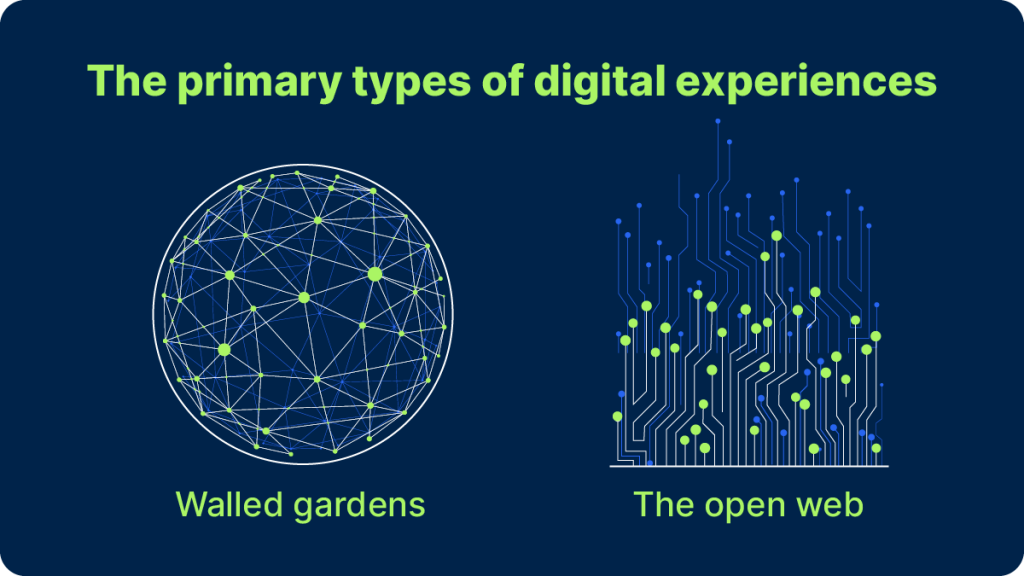
Der Hauptunterschied zwischen den beiden besteht darin, dass Walled Gardens den Zugang zu ihren First-Party-Daten einschränken - wie ein Garten, der hinter einer Mauer liegt -, während dies im offenen Web nicht der Fall ist. Social-Media-Websites sind ein Beispiel für Walled Gardens, während Websites und Apps wie Weather.com, Words With Friends und CNN Teil des offenen Webs sind.
Dies ist eine wichtige Unterscheidung für Messzwecke: Technisch gesehen sollte ein Walled Garden eine ziemlich klare Vorstellung davon haben, wer auf Inhalte zugreift und Anzeigen auf seiner Plattform sieht. Wenn jedoch andere Unternehmen ihren Anzeigen- oder Inhaltskonsum innerhalb dieser Walled Gardens messen wollen, müssen sie in der Regel individuelle Integrationen erstellen, die mit den Datenschutzbestimmungen vereinbar sind.
Websites im offenen Web können zwar über robuste und authentifizierte Daten von Erstanbietern verfügen, aber das ist nicht immer eine Selbstverständlichkeit. In diesen Fällen verlassen sich allgemeine Websites oft auf Proxy-IDs und andere Ad-Tech-Lösungen, um Nutzer zu identifizieren, anzusprechen und zu messen.
Aktuelle Herausforderungen der Branche
On the open web, the ongoing deprecation of third-party cookies and device IDs is making it more difficult to identify users and is forcing stakeholders to rethink their measurement approach. Apple’s decision in 2021 to change default app tracking permissions (from opt-out to opt-in) wiped out three-fourths of IDFAs (Apple’s mobile ad IDs) from consideration. And Google is scheduled to phase out third-party cookies in the second half of 2024, the final blow to an ID system that held up for the most part, but was always an imperfect solution. Cookies aren’t people, after all.
For walled gardens, the practice of sharing granular subscriber data with outside parties is largely a thing of the past, even for anonymized measurement purposes. To comply with major data global privacy regulations, walled gardens are now sharing activity data with advertisers and measurement companies in aggregate form, if they’re sharing it at all.
Das sind ernsthafte Herausforderungen für die Messung, die die Branche dazu gezwungen haben, nach anderen Identifikatoren, Signalen und Attributen für die Verbraucher zu suchen. Und alles beginnt mit einem Eindruck.
Was genau ist ein digitaler "Eindruck"?
Bevor wir ins Detail gehen, wie ein moderner digitaler Messprozess aussieht, sollten wir klären, was ein Eindruck ist.
Impressionen messen die Anzahl der Aufrufe einer Anzeige oder eines Inhalts auf einem digitalen Gerät. Die Impressionen geben Aufschluss darüber, wie oft Ihre Anzeige oder Ihr Inhalt insgesamt gesehen wurde, aber sie messen nicht, wie viele Personen die Anzeige tatsächlich gesehen haben. (Das ist die Reichweite.) Wenn also zum Beispiel fünf Personen Ihre LinkedIn-Anzeige zweimal gesehen haben, bedeutet das, dass Ihre Kampagne 10 Impressionen hat.
Die aktuellen Richtlinien für die Sichtbarkeit digitaler Medien zur Qualifizierung einer Impression sehen vor, dass eine Anzeige zu mindestens 50 % auf dem Bildschirm des Nutzers zu sehen sein muss - und nicht etwa hinter einem anderen Fenster versteckt oder im Hintergrund abgespielt werden darf - und zwar mindestens eine Sekunde lang bei Display-Anzeigen und zwei aufeinanderfolgende Sekunden bei Video-Anzeigen. Die Schwellenwerte für die Impressionszeit und die Sichtbarkeit bilden nun eine solide Grundlage für Werbetreibende und Publisher, um die Bedingungen für ihre Medientransaktionen festzulegen.
Nachdem wir nun wissen, welche digitalen Aktivitäten wir messen, wollen wir uns nun damit beschäftigen, wie wir sie messen.
5 wichtige Schritte im digitalen Messprozess
Bei Nielsen betrachten wir die digitale Messung als einen fünfstufigen Prozess:
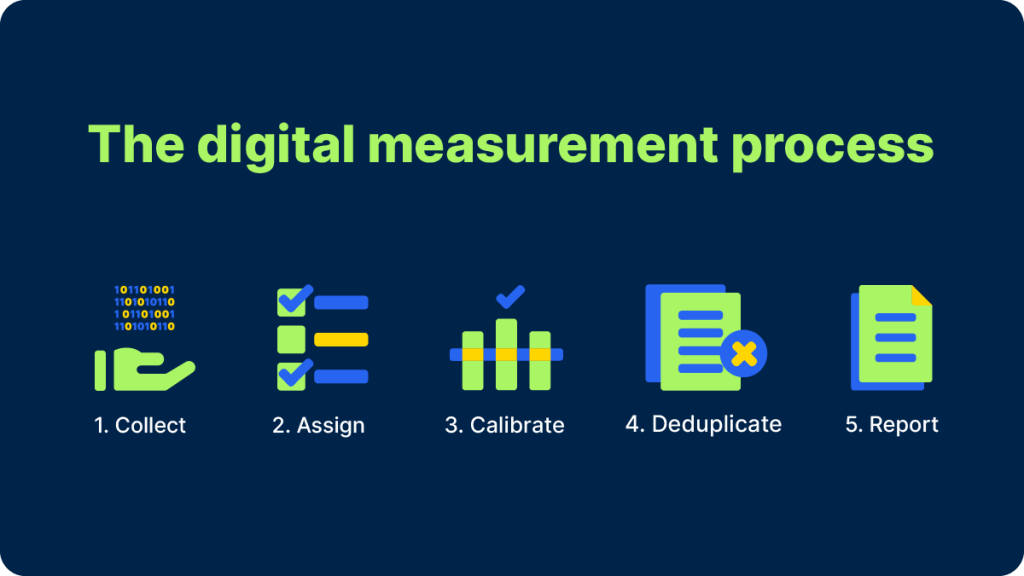
Schritt 1: COLLECT
The first step in the process is to make sure that the content and ads data is all properly captured and identified. For web content, a page URL is an acceptable identifier, but there might be multiple ads on a single url that will need to be uniquely identified. For content measurement, clients’ integrate Nielsen’s SDK3 within their websites or apps. For ads measurement, we either use direct integrations with publishers, or ask advertisers or their agencies to integrate Nielsen tags in their ads when they traffic campaigns. When ads are delivered to the user’s browser or app, those Nielsen tags ping our servers with information about the ad that was delivered along with important meta-data information that enables us to filter out any invalid robotic traffic. Javascript tags, on top of all the campaign data, capture additional signals for measuring second-by-second viewability data (for display and video ads) and audio volume levels (for video ads). This allows us to accurately collect all the impression data.
Schritt 2: ASSIGN
The next step is to assign those impressions to a person. With the ecosystem changes discussed above, we’re now transitioning to a system where cookies are replaced with alternate identifiers and first-party data provided by clients—such as hashed email addresses, Unified ID 2.0 or self-reported demographic labels—and verified against our own growing ID graph. The goal is to get as close as possible to the demographic profile of the person who was exposed to the content or ad, and if that’s not possible, at least attach some useful information about their behavior and interests.
Schritt 3: KALIBRIEREN
Then, you need to calibrate your data for demographic accuracy. It’s important to acknowledge that even the best demo assignment process in the world will still return many cases where the user couldn’t be identified, and those misses can’t be assumed to be randomly distributed across all demographic groups. This may lead an advertiser to draw erroneous conclusions about the impact of their campaign. A panel can be used as a source of truth to calibrate census-level impressions. At Nielsen, we maintain digital and participant panels of 725,000 for exactly that purpose. Some are equipped with a computer meter, others with a mobile meter to measure their app and web usage on smartphones and tablets. And we make sure we have accurate demographic and profiling data for everyone in the panel
Schritt 4: DEDUPLIKIEREN
Next, you must ensure your campaign reach isn’t inflated across devices . Over the course of a campaign, people are typically exposed to it many times, especially when that campaign is running on multiple walled gardens and on the open web. Multiple exposures are generally a good thing—it takes a few impressions to make an impression—but advertisers are rightfully very mindful of ad waste4 and putting off consumers with repetitive ads. Deduplicating reach—that is, ensuring the same viewer isn’t counted multiple times—and calculating a campaign’s true frequency are critical steps in the measurement process.
Schritt 5: BERICHT
Finally, you need to monitor performance. Everything above needs to happen on a continuous basis, and actionable reports need to be available as quickly as possible to give marketers the insights they need to reallocate funds to their most effective channels and most receptive audiences while their campaign is still in flight and there’s still time to change course.
Auf dem Weg zur medienübergreifenden Messung
Die Messbranche steht unter großem Druck, sich an die massiven Veränderungen anzupassen, die im digitalen Ökosystem bereits im Gange sind. Werbetreibende brauchen einen klaren Überblick über die Kampagnenleistung auf allen digitalen Geräten, Vertrauen in die Ergebnisse und zuverlässige Tools zur Optimierung ihrer Kampagnen im Flug.
But there’s even more pressure to get digital and TV impressions on a level playing field. This is an ongoing effort—what constitutes an impression on linear TV and on digital platforms aren’t the same yet—but thanks to the development of a common ID system and launch of Nielsen ONE, we’re already helping marketers deduplicate reach and frequency across select digital and linear platforms in key markets around the world.
At Nielsen, we’ve also recently launched ‘Always On’ digital measurement with proactive partners like YouTube to emulate the way that linear measurement is done and help marketers turn on digital measurement capabilities on a continuous basis, rather than campaign-by-campaign.
Es gibt noch viel zu tun, damit die vollständige medienübergreifende Messung in unserer Branche Realität wird, aber mit den richtigen Prioritäten, Tools und Prozessen sind wir näher dran als je zuvor.
Nielsen’s Need to Know reviews the fundamentals of audience measurement and demystifies the media industry’s hottest topics. Read every article here.
Sources
1For an overview of TV measurement, read Need to Know: How Are TV Audiences Measured?
2Connected-TV platforms and retail media networks share many characteristics with both walled gardens and the open web. Stay tuned for a future Need to Know article on those fast-growing media channels.
3The Nielsen software development kit (SDK) is one of multiple framework SDKs that Nielsen provides to measure both static and video content across platforms.
4Nielsen’s Digital Ad Ratings estimate that 37% of digital ad spend is currently wasted on impressions that are off-target, out-of-view or SIVT.