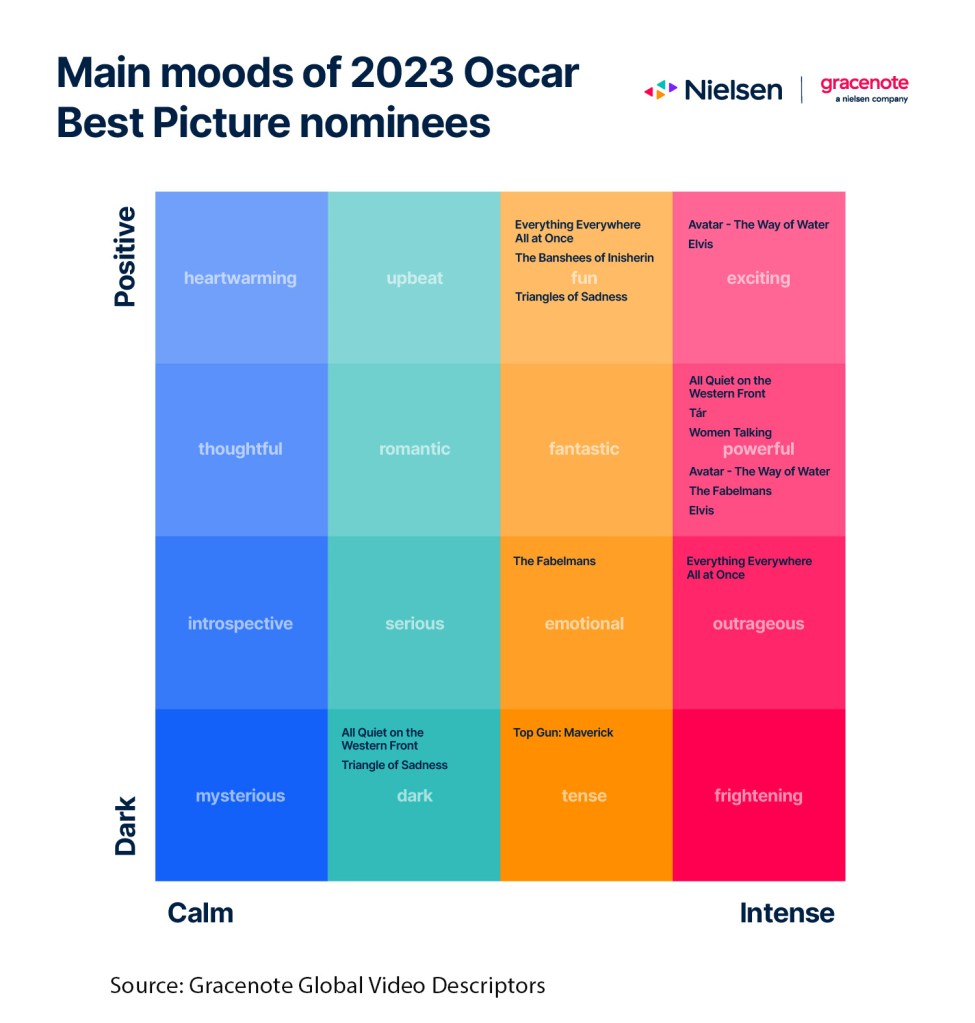
In addition to bringing star-packed entertainment to the big screen, the films nominated for best picture awards at the upcoming 95th Academy Awards provide insight into the moods that the filmmakers aspired to capture in their projects. And this year, the nominated movies break a trend we’ve seen in five of the last six best picture winners: “Powerful” and “fun” are the dominant moods we see in the movie metadata—a pivot from “emotional” films, which have been dominant since 2017.

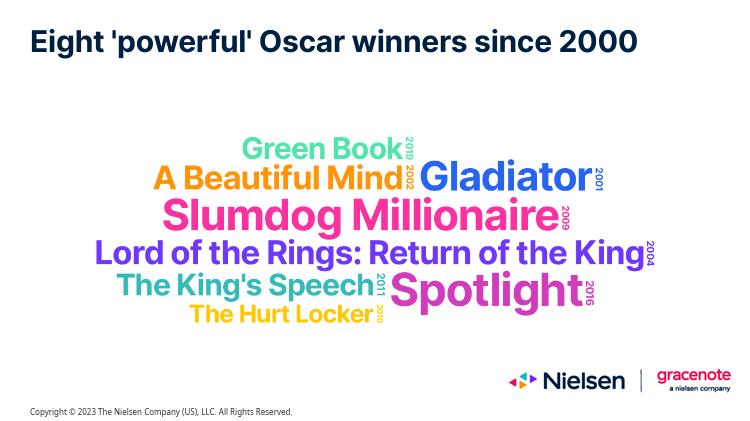
Out of the 10 movies up for best picture this year, The Fabelmans stands alone in being classified as “emotional,” according to Gracenote Video Deskriptoren. Comparatively, films like All Quiet on the Western Front, Avatar-the Way of Water und Women Talking have brought the “powerful” mood back to the forefront this year, as there are six “powerful nominees in total. Last year, there were only three “powerful” films nominated for best picture (Dune, The Power of the Dog und King Richard). In total, eight of this century’s best picture winners have been classified as “powerful.”
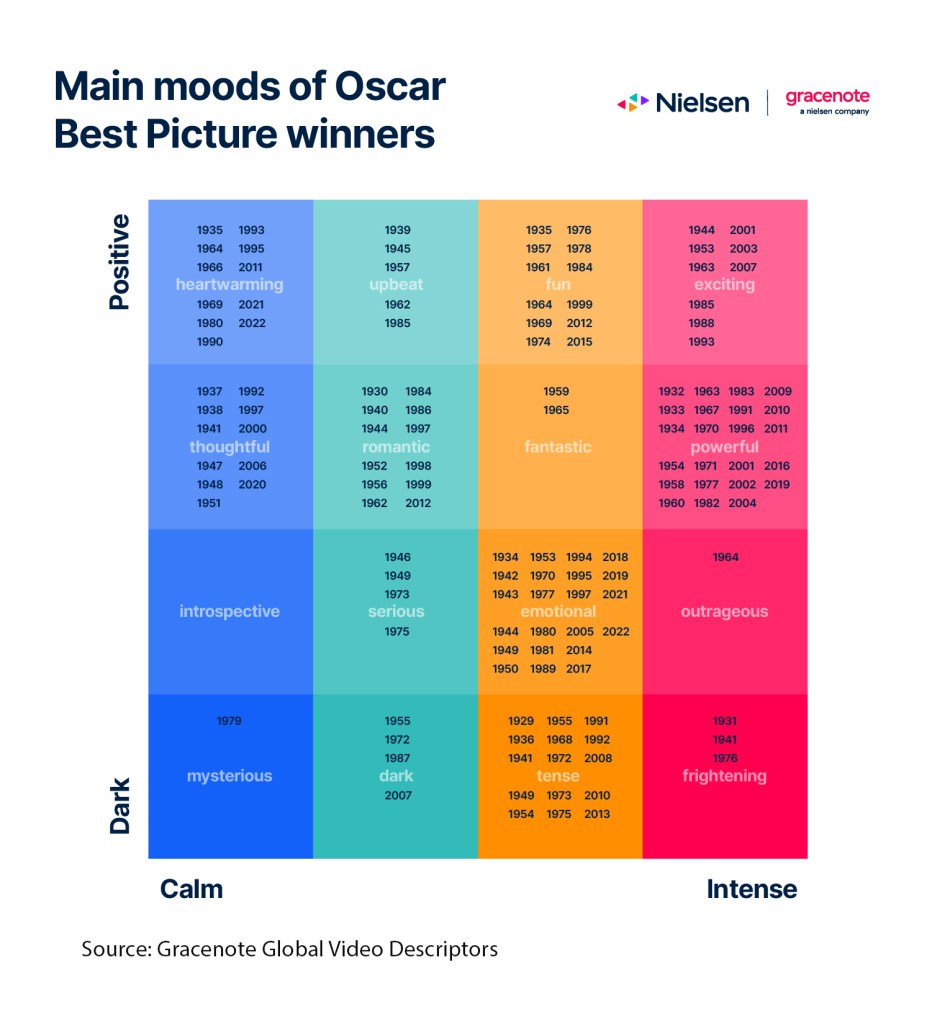
Da nur eine der diesjährigen Nominierungen für den besten Film als "emotional" eingestuft wurde, ist die Wahrscheinlichkeit groß, dass wir eine Veränderung in der jüngsten Geschichte erleben werden. Ob es nach diesem Jahr zu einer größeren Verschiebung kommt, wird von den Gewinnern der nächsten Jahre abhängen. Bislang haben "emotionale" Filme in der Kategorie Bester Film schon lange vor 2017 dominiert. In der 94-jährigen Geschichte der Oscar-Verleihung waren 22 Gewinner "emotional", gleich nach "kraftvoll", das bei 23 Gewinnern im Vordergrund stand. Umgekehrt sind "introspektiv" und "sinnlich" die einzigen beiden Hauptstimmungen (von 17), die nicht mit den Gewinnern der Kategorie "Bester Film" in Verbindung gebracht wurden.
Trotz des Mangels an "emotionalen" Filmen bei den diesjährigen Nominierungen für den besten Film hat die Akademie die Stimmung in diesem Jahr nicht völlig ignoriert: Fünf der sechs Hauptdarsteller-Nominierungen entfallen auf Filme, die mit der "emotionalen" Stimmung in Verbindung gebracht werden.
“Fun” is the other popular mood among this year’s best picture nominees: Everything Everywhere All At Once, The Banshees of Inisherin und Triangle of Sadness all have “fun” as their primary mood.
Despite its presence this year, “fun” isn’t a mood that has been associated with Best Picture winners in recent years. Since the turn of the century, only 2015’s Birdman and 2012’s The Artist have been categorized as “fun” movies.
Last century, the most successful period for “fun” movies at the Oscars was between 1969 and 1978, when Oliver!, The Sting, One Flew Over The Cuckoo’s Nest und Annie Hall each made off with Best Picture awards. Aside from the two this century, there have only been two “fun” winners since: Terms of Endearment (1984) and Shakespeare in Love (1999).
Film-Metadaten liefern Informationen über die Hintergründe eines Films
Wichtig ist, dass sich die Aufgabe der Video-Deskriptoren nicht darauf beschränkt, die mit den Filmen verbundenen Stimmungen zu beschreiben. Metadaten werden verwendet, um einen Großteil der Informationen hinter den Kulissen eines Films zu beschreiben, wie z. B. Thema, Szenario, Schauplatz und Genre, die von Plattformen genutzt werden können, um die Entdeckungsreise des Publikums zu unterstützen. Videodeskriptoren können auch Aufschluss über die Zeiträume geben, in denen die Filme spielen.
Before the mid 1950s, best picture winners most frequently featured the time periods in which they were filmed, particularly between 1939 and 1956. During this period, 13 of the 18 best picture winners were set when they were filmed. Halfway through the century, historical epics gained in prominence, with Around the World in 80 Days, The Bridge on the River Kwai, Ben-Hur und Lawrence of Arabia all took the best picture award in a span of seven years starting with the 1957 ceremony. Musicals, many of which include a historical setting, were also at their height during this period, with Gigi, West Side Story (which was contemporary), My Fair Lady, The Sound of Music and Oliver! winning the best picture award between 1959 and 1969.
Historical settings have remained popular among best picture winners in the years since, but only two of the best picture winners since 1999’s Shakespeare in Love were set before 1920 (2001’s Gladiator and 2014’s 12 Years a Slave). More recently, films with contemporary settings have come back in fashion, as the best picture winners between 2012 and 2019 were all set in the times in which they were filmed.
One time period that has never resonated with the Academy, however, is the future. And while this year’s Everything, Everywhere, All At Once includes sequences that take place in parallel settings, its primary time period is contemporary. And when it comes to fantasy themes, 2004’s The Lord of the Rings:The Return of the King stands alone as a best picture winner throughout the 94-year history of the Oscars.
In addition to looking into movie metadata to find commonalities among Academy-nominated films over time, these types of descriptors are critical in helping audiences find what they’re looking for when the titles become available to watch at home. With more than 976,000 unique video titles1 available to audiences as of January 2023, applying hyper-detailed meta descriptions, including mood, can help platforms curate more personalized video experiences for content-hungry audiences.
Hinweis
- Gracenote Globale Videodaten