Wie jeder Fan bestätigen kann, kann Musik viel mehr als nur unterhalten. Sie hat die Macht, uns anzuregen, zu inspirieren und zu transportieren. Die Stimmung spielt dabei eine entscheidende Rolle, und die Interpreten der 67. Saison des Eurovision Song Contest werden eine Reihe von Emotionen ansprechen, um die richtigen Akkorde bei einem begeisterten - manchmal sogar fanatischen - Publikum zu treffen.
To do so, the performers plan to get intense with audiences by leaning into energetic moods and shifting away from the neutral moods that were more prevalent last year. In total, seven of this year’s 37 songs fall into the “energizing” mood category1—the most prominent primary mood descriptor2 across all of the entries. While we saw an equal number of “energizing” entries last year, this year’s contest will feature more songs with other energetic undertones.
Letztes Jahr zum Beispiel war "Sehnsucht" die häufigste Stimmung (es gab neun) unter den eingereichten Liedern; dieses Jahr sind es nur vier. Ebenso gibt es in diesem Jahr keinen Song mit der Hauptstimmungsbeschreibung "sinnlich"; im letzten Jahr waren es fünf. Außerdem gibt es doppelt so viele Lieder mit den Hauptstimmungen "aufgeregt" und "trotzig": vier bzw. zwei.

The shift toward more energetic moods bodes well for competitors, as half of the 24 winning songs between 1998 and 2022 were characterized by five moods at the more energetic side of the spectrum: “energizing,” “excited,” “fiery,” “rowdy” and “urgent.” And in the last decade, seven of the last 10 winning songs have expressed at least one of these moods. This year, 19 of the 37 entries express “energizing,” “excited,” “fiery,” “rowdy” or “urgent” as their main mood.
Of these five moods, “fiery” is the most common among winners since 1998, including last year, when “Stefania,” Ukraine’s entry from hip-hop band Kalush Orchestra, took the top prize. “Stefania” was one of three entries with a “fiery” primary mood.
Dana International’s win for Israel in 1998 with her song “Diva” was the first entry with a “fiery” primary mood descriptor to take the top prize. Her win also kicked off a trend that we’ve seen hold through 2022: 14 winners have featured moods at the more energetic end of the spectrum. Israel’s win in 1998 was also more in tune with the pop music of the time—a shift that has carried through most of the contests in the years that followed.
Im Vergleich dazu waren die Siegerlieder der ersten 42 Auflagen des Wettbewerbs, der 1956 begann, weniger energiegeladen: Nur vier der 45 Gewinner (1969 gab es vier Co-Gewinner) in diesem Zeitraum waren Lieder mit einer energiegeladeneren Stimmung. Die Grundstimmung der anderen Lieder war durchschnittlich und unterdurchschnittlich energiegeladen.
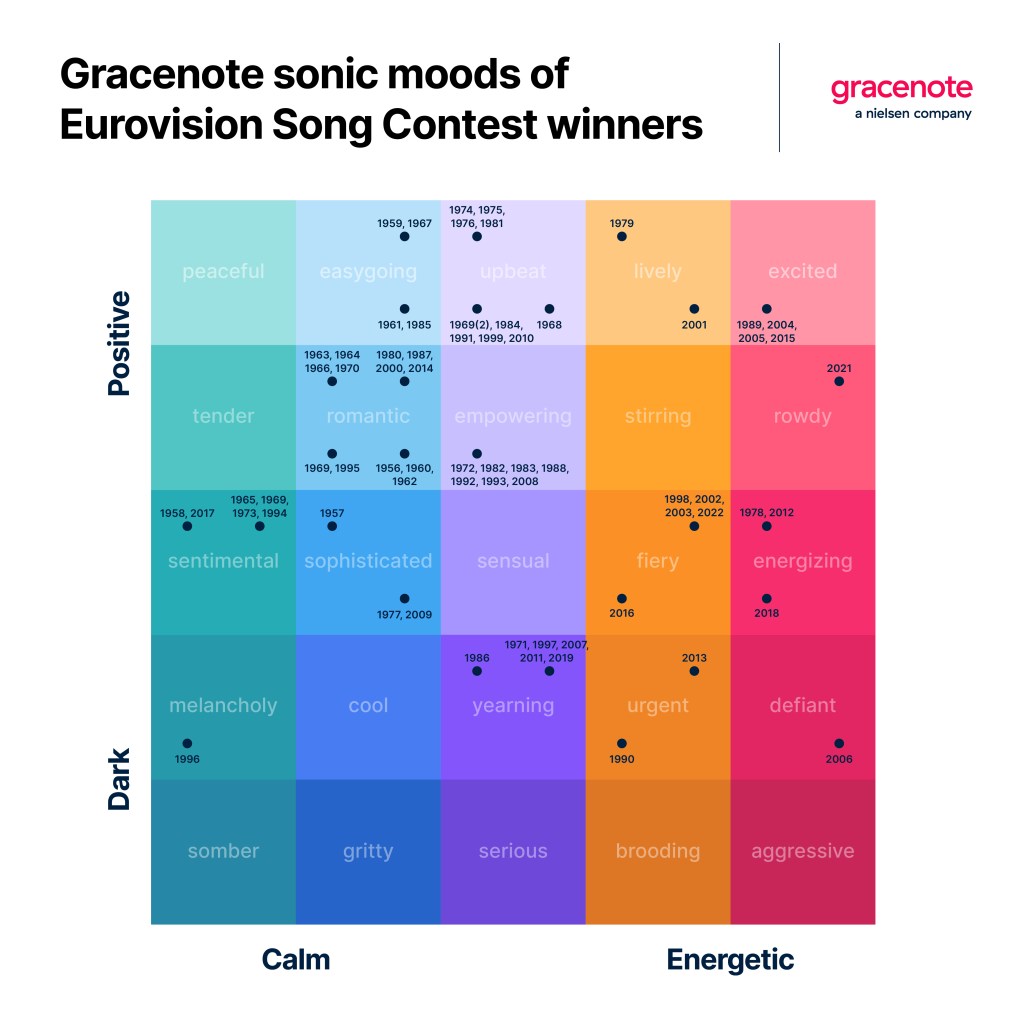
In total, this year’s entries cover less emotional range than last year, as the songs cover just 12 primary moods—down from 15 in 2022. Entries are more heavily stacked in the positive and energetic areas of the mood spectrum, which puts more songs in contention to win from a recent historical perspective. In looking at the top 10 contenders to win, based on the odds at eurovisionworld.com, seven exhibit one of the five moods that have dominated in recent years, suggesting that history will likely repeat itself when the final vote is tallied following this year’s contest.
Der diesjährige Wettbewerb beginnt am 9. Mai 2023. Die Halbfinalspiele finden am 11. Mai statt, das Finale am 13. Mai.
Anmerkungen
1 As categorized by Nielsen’s Gracenote music data
2 Gracenote’s Sonic Mood Descriptors feature 25 level one mood descriptors. These descriptors indicate the most prominent and distinct elements in a song, such as rhythm, melody, and timbre. Combined, they provide a “mood profile” of a song, which indicates the primary mood and strength.