As audiences continue to increase their streaming consumption, sports are ready to join the ranks of hit programs like Fremde Dinge, Nur Morde im Gebäude und Obi-Wan Kenobi. And with new streaming-exclusive deals involving the NFL and MLS in play, fans are ready, as more than one-third of U.S. homes now access TV programming strictly through an internet connection1.
While more than 90% of the homes in the U.S. have access to the internet, the growing abundance of video streaming services and content—both live and on-demand—provides audiences with ample choice outside of traditional TV options. And select sports leagues are transitioning as well. This year, the NFL’s Thursday Night Football (TNF) became exclusive to Amazon Prime Video; and starting next season, MLS matches will be exclusive to a new streaming service within the Apple TV app.
These two rights deals signal the shift that has been building as emerging digital platforms have progressively increased their stakes in sports rights. While some deals will continue to involve a mix of linear and streaming, such as the new Big Ten Conference deal, recent viewership trends illustrate how comfortable fans are in accessing sports content without traditional broadcast and cable access.
According to Nielsen Fan-Insights, 80% of sports fans, 76% of NFL fans and 89% of soccer fans have regularly or sometimes watched sports on any streaming or online channel this year.
Aus der reinen Zuschauerperspektive scheint das Publikum mit dem Streaming von NFL-Spielen auf Amazon weitaus mehr zu tun zu haben als mit dem Anschauen von Spielen im Premium-Kabel. Nielsen TV-Zuschauerdaten zeigen, dass die ersten drei TNF-Spiele auf Amazon Prime Video in diesem Jahr deutlich mehr Zuschauer (13 Millionen, 11 Millionen bzw. 11,7 Millionen) anzogen als jedes der sieben Donnerstagsspiele des letzten Jahres, die nur auf dem NFL Network ausgestrahlt wurden.
Diese Zuschauerzahlen verdeutlichen, wie viel sich verändert hat, seit Twitter in der NFL-Saison 2016/17 erstmals 10 TNF-Spiele neben den traditionellen Übertragungen gestreamt hat, und die Haushalte, die ihre TV-Inhalte über eine Internetverbindung beziehen, sind bereit.
These homes, dubbed broadband-only homes2, spend an oversized amount of time with sports programming, along with local and national news. Across the top 56 U.S. local markets where Nielsen measures TV audiences, BBO households are 36% more likely to watch sports events than the average TV household. In some markets, they are twice as likely to view sports events3.
As a genre, sports has been slower to migrate to streaming platforms, but audiences’ appetite for over-the-top content continues to grow. In August 2022, streaming captured 35% of total TV time, capping six consecutive months of viewership highs. Access preference is even clearer when we look at the decline in the number of TV households that receive their content solely from a cable or satellite provider.
Es überrascht nicht, dass sich die Zusammensetzung der BBO-Haushalte erweitert hat, da der Anteil dieser Haushalte im Laufe der Zeit gestiegen ist. Während die Wahrscheinlichkeit, in einem BBO-Haushalt zu leben, bei den 25- bis 34-Jährigen am größten ist (58,7 %), haben die Internetverbindung, der Internetzugang und die Verfügbarkeit von Inhalten zu einer viel breiteren Akzeptanz in der Bevölkerung geführt. So leben beispielsweise mehr als 51 % der Kinder zwischen 2 und 11 Jahren in einem BBO-Haushalt, ebenso wie fast ein Viertel der Erwachsenen zwischen 50 und 64 Jahren. Noch vor fünf Jahren lebten nur 2,1 % der Erwachsenen zwischen 50 und 64 Jahren in einem BBO-Haushalt.
Auch wenn die Zusammensetzung der BBO-Haushalte immer breiter wird, sind die meisten jünger, größer und verdienen mehr als der durchschnittliche US-Haushalt. Und es überrascht nicht, dass die höchste Konzentration von BBO-Eigenheimen in den großen Ballungsräumen zu finden ist, einfach aufgrund des Zugangs zur Infrastruktur.
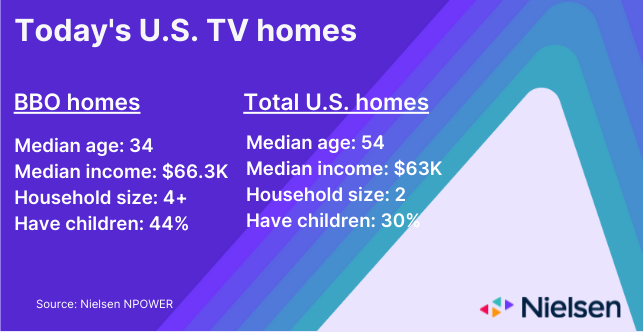
In den kommenden Jahren erwarten wir, dass sich die Zusammensetzung der BBO-Haushalte und ihre geografische Konzentration erweitern wird, vor allem aufgrund der vielen Initiativen, die eingeführt werden, um erschwingliche, zuverlässige Hochgeschwindigkeits-Internetzugänge in unterversorgten Gebieten bereitzustellen.
On Sept. 22, 2022, for example, the Biden-Harris administration announced $502 million in loans and grants in the third funding round of the USDA’s ReConnect Program to provide rural residents and businesses in 20 states with high-speed internet access. In total, Biden’s Bipartisan Infrastructure Law provides $65 billion to expand affordable, high-speed internet to all communities across the U.S. And at a more local level, an array of counties, cities and towns are making similar commitments to deliver and expand broadband infrastructure, such as Kenosha, Wis., rural North Carolina und Whiteside County, Ill.
The increasing focus on new broadband infrastructure, coupled with Americans’ plans to increase their streaming usage in the coming year, serves as additional evidence that audiences will continue gravitating to over-the-top, digital content options, including sports—one of two genres that remains a fixture within traditional linear TV programming. Given the strong appetite for sports and news among BBO homes, combined with the significant audience engagement with the first TNF game on Amazon, it’s likely that streaming services will continue to expand by offering different genres that BBO viewers are clamoring for.
Anmerkungen
- Nielsen NPOWER
- Haushalte, die nur über Breitband verfügen, empfangen ihr Fernsehprogramm über eine Hochgeschwindigkeits-Internetverbindung
- Nielsen Local TV Messung Juli, 2022
A version of this article originally appeared on Streaming Media.