
Two of my three daughters, ages 4 and 6, are the biggest women’s soccer fans you’ll find. My youngest, age 1, has started to dribble, but she’s still too young to know what a fan is. They frequently host front-yard matches that feature our beloved home team, the Washington Spirit, facing another team from the National Women’s Soccer League (NWSL). We’ve also had the pleasure of attending a few games in person, but our family ritual of watching the Spirit on TV is what really cemented their fandom—until recently.
In dieser Saison wurde die überwiegende Mehrheit der 24 regulären Saisonspiele der Spirit von unserem lokalen regionalen Sportsender (RSN) im Fernsehen auf Streaming-Plattformen übertragen. Kurz vor der Saisoneröffnung musste ich mich also bei Paramount+ anmelden, das in diesem Jahr 16 Spirit-Spiele überträgt, nur um festzustellen, dass die App nicht auf meinem Smart-TV verfügbar ist. "Es ist besser für mich, es auf dem Fernseher zu sehen", murrte mein mittleres Kind, als es sich mit seiner Schwester um eine bessere Sicht auf das iPad drängelte. Wir haben 30 Minuten Action gesehen, bevor die Mädchen um 20 Uhr ins Bett mussten, aber das war's auch schon, denn Paramount+ bietet keine vollständigen Wiederholungen an, wie es bei DVRs der Fall ist.
Kurz vor Spiel 2 entdeckte ich, dass es auf Twitch lief, einer separaten App, die in dieser Saison fünf Spirit-Spiele streamt. Aber wie schon zuvor mussten wir das Spiel auf dem Tablet anschauen. "Daddy, ich muss auf die Toilette gehen. Kannst du das bitte anhalten?", fragte mein Ältester, woraufhin ich antworten musste: "Tut mir leid, es gibt keine Pausen wie beim Fernsehen."
Es war für uns nicht die reibungsloseste Erfahrung, aber wir werden dranbleiben. Meine Töchter lassen mir keine andere Wahl, und zum Glück hat unsere Familie die Geräte, die Internetverbindung und das Budget, um dies zu tun. Aber hat der durchschnittliche Sportfan auch den Wunsch, die Zeit und die Mittel, dies zu tun? Die Antwort wird aller Wahrscheinlichkeit nach über die Zukunft des Frauensports (wenn nicht sogar des Sports insgesamt) entscheiden.
Women’s sports have always been hard to find on TV. Aside from the Olympics, World Cup soccer, golf and tennis, women’s sports have taken a distant back seat to men’s for decades. Nielsen data show that in 2019, the last full pre-COVID season, 96% of televised professional basketball games were of the NBA, while only 4% were of the WNBA. Pro golf was slightly more equitable, with 77% of events with men, 18% women (and 5% both men and women), but still nowhere close to gender parity. One shouldn’t expect a multi-billion dollar industry with a status quo rooted in men’s sports to change overnight, but there’s a growing consensus that it must make progress and soon.
Why is gender equity in sports media so important? It’s not only the right thing to do, but it also has a profound effect on industry economics. There is a direct correlation between the audience size of a sports league’s televised events and the financial health of that league. By way of example, the 256 regular season NFL games last year delivered an average audience of over 15 million viewers, and seven games were among the top 10 highest rated primetime TV shows in 2020. So it’s not surprising that the NFL commanded a whopping $10 billion per year in its most recent media rights deal and provides a very comfortable minimum player salary of $610,000 per year.
Comparatively, only nine NWSL games were televised in 2020, with an average audience of 434,000 viewers, 35 times smaller than that of the NFL (1). So it’s understandable that the NWSL’s latest rights deal was also smaller, reportedly $1.5 million per year, leading to a much lower minimum player salary, $20,000 per year. Therefore, more viewers equals more money and, even in the year 2021, TV audience sizes still matter and quite a lot.
So if you’re a sports league or media partner of one, what should you do? You should maximize total viewership however possible, regardless of platform, using a strategic set of media channels, both streaming and linear TV. After all, if you’re trying to grow your fan base, shouldn’t you make your product available to as many people as possible? A best practice is what I’d call the “barbell strategy.” On one end of the barbell is streaming, also known as connected TV (CTV), which accounted for 27% of total TV usage in June 2021 in the U.S. An ideal approach would prioritize high-reaching, ad-supported streaming apps that are free to the consumer, which minimizes a viewer’s “barrier to entry.”
On the other end of the barbell is traditional, or linear, TV. Despite Americans increasingly “cutting the cord,” linear TV is still the overwhelming way that people watch TV, sports in particular. For example, in June 2021, 49 million households watched ESPN or a RSN. This compares with the 30 million who watched a network streaming app. The vast majority (73%) of ESPN/RSN watching households did not watch a network streaming app (2). Therefore, sports leagues, women’s included, just can’t afford not to have a strong linear TV presence (and putting just a few playoff games on broadcast networks is not enough). In a perfect world, TV distribution would leverage both RSNs (to foster and capitalize on home-team loyalty) and national TV networks (to drive reach and awareness among the general population).
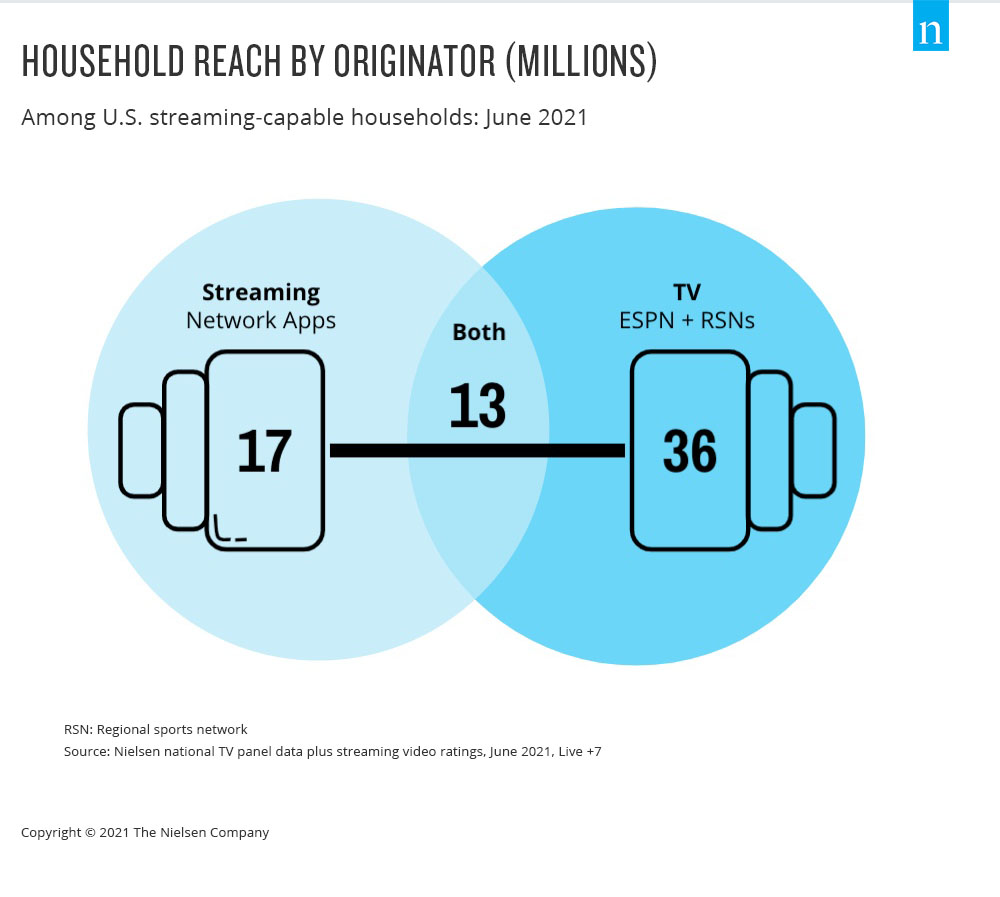
Insgesamt maximiert eine gut umgesetzte Barbell-Strategie die Reichweite durch die Wahlmöglichkeiten der Verbraucher; Zuschauer, die lieber streamen, werden streamen, und diejenigen, die lieber im Fernsehen sehen, ob live oder zeitversetzt, werden dies auch tun. Entscheidend ist, dass sich diese beiden Gruppen in hohem Maße ergänzen und in der Summe die größtmögliche Einschaltquote erzielen.
And for those who believe that such a strategy isn’t realistic because one can’t reasonably expect profit-driven TV networks to carry lower-viewership women’s sports, I’d offer two counterpoints. First, to paraphrase Cathy Engelbert, Commissioner of the WNBA, you first need to televise women’s sports sufficiently in order to give them a fair shot at achieving greater viewership. Rome wasn’t built in a day and the NFL has been on TV for 82 years. Second, small audiences for men’s boxing, drag racing, esports and soccer (3) (with Major League Soccer having lower 2021 average viewership than the NWSL) hasn’t prevented these sports from airing prominently on national TV.
Maximizing content reach has the added benefit of driving brand impact. The brand here is the league. You’d be surprised how few people are even aware that certain sports leagues exist. Harder still is producing the high level of awareness that’s required to drive viewership intent across large numbers of people. Key to the mix is not just the content itself, but also promotions, including paid, owned and earned, which further drive awareness and intent to view. Content and promotions reaching sufficient numbers of the right people creates a virtuous cycle.
Das Bewusstsein führt zu der Absicht, etwas zu sehen, und damit zu einer tatsächlichen Zuschauerzahl und schließlich zu einem großen Stammpublikum, das große Werbetreibende, lukrative Medienrechte und finanziellen Erfolg für Fernsehsender, Streaming-Apps, Ligen und Spielerinnen gleichermaßen anzieht. Andererseits wird die Alternative, den Frauensport auf abonnierte Nischen-Streaming-Apps zu beschränken, so modern sie heutzutage auch sein mögen, und ein paar unbedeutende TV-Ausstrahlungen zuzulassen, aller Wahrscheinlichkeit nach die derzeitigen Trends der relativen Unbekanntheit und des finanziellen Misserfolgs fortsetzen.
Um mit einer persönlichen Bemerkung zu schließen: Die letzten Jahre haben viele von uns dazu veranlasst, nach einem tieferen Sinn in unserem Berufsleben zu suchen, und als Vater von drei kleinen Mädchen ist dies meiner. Wenn es um Gleichberechtigung in den Medien geht, auch in Bezug auf die Geschlechter, sind wir in der Branche meiner Meinung nach in einer einzigartigen Position - und haben eine besondere Verpflichtung -, dies tatsächlich zu verwirklichen. Ich hoffe, dass, wenn meine Töchter in meinem Alter sind, der Frauensport genauso zugänglich und erfolgreich sein wird wie der Männersport, und dass sie diesen Leitartikel als eine kuriose Erinnerung an längst vergangene Jahre betrachten werden.
Anmerkungen
(1) 434,000 viewers is the weighted average of the seven televised Fall Series games and the two televised Challenge Cup games
(2) Nielsen National TV Panel Daten plus Streaming Video Ratings; unter streaming-fähigen Haushalten, Juni 2021, live +7
(3) Nielsen National TV Panel Daten, P2+, Januar-Juni 2021, live +7