Ganz gleich, um welche Sportart es sich handelt, die Liebe der Fans zum Spiel - und zu ihrer Lieblingsmannschaft - ist groß. Diese Liebe ist die Grundlage für Familientraditionen, Rivalitäten in der Gemeinde und stundenlanges Einschalten. Es ist auch eine Liebe, die für die amerikanische Kultur von zentraler Bedeutung ist. Aber was passiert, wenn dieses Gefühl der Verbundenheit auf Kosten einer Kultur oder eines Erbes geht, die über Jahrhunderte hinweg im Namen der Amerikanisierung Schaden genommen haben? Für viele amerikanische Ureinwohner gehören die Aneignung heiliger Symbole und die Verbreitung von Stereotypen im amerikanischen Sport auf Profi-, College- und K-12-Ebene zur Tagesordnung. Aber viele der heutigen Fans sind der Meinung, dass das nicht so bleiben muss.
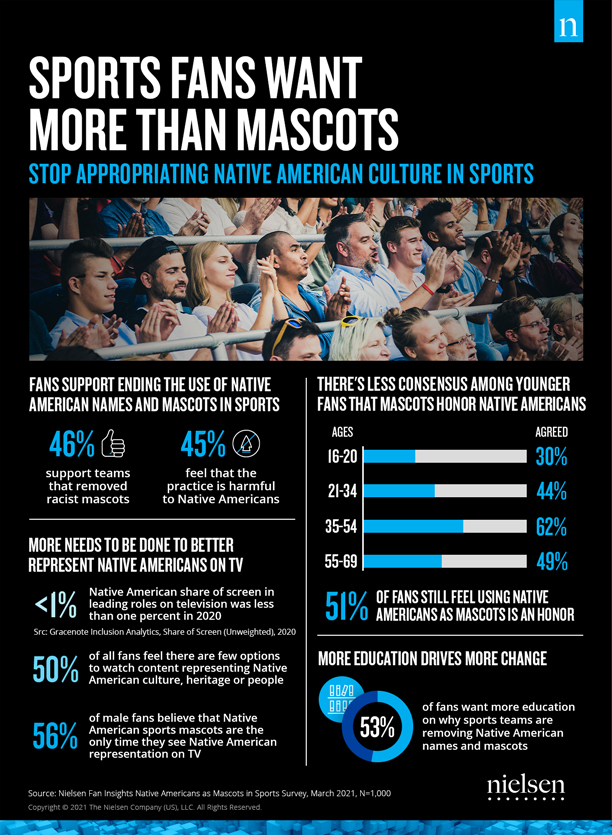
Fans applaud the shift away from the appropriation of Native American culture as mascots. In fact, a recent Nielsen Fan-Insights survey in collaboration with IllumiNative found that 46% of respondents believe teams are doing the right thing by changing their names and stopping the use of culturally insensitive mascots. For example, after years of pressure, the Washington Football Team finally retired the use of its former name and logo in 2020. The Cleveland Indians made a similar move at the start of the 2019 baseball season when it stopped using its former mascot, Chief Wahoo.
But 45% of fans want sports teams to do more than just stop using culturally insensitive mascots and names. They want them to end the appropriation of Native American culture as well, citing the harm it does to the community and the damaging emotional effects on Native Americans. And much of the appropriation starts in school sports, which the American Psychological Association says establishes an unwelcome and oftentimes hostile learning environment for American Indian students that affirms negative images/stereotypes that are then promoted in mainstream society.
Die Cleveland Indians sind einen Schritt weiter gegangen, als sie ihr altes Maskottchen abschaffen wollten, als sie im Dezember letzten Jahres ankündigten, ihren Namen zu ändern, der als neutraler empfunden wird als das frühere Maskottchen. Die schrittweise Entwicklung des Mannschaftsnamens spiegelt wider, wie die Verbraucher von der Intoleranz gegenüber anstößigen Maskottchen zur Intoleranz gegenüber jeglicher kultureller Aneignung übergegangen sind.
In some instances, sports organizations and teams had good intentions, using Native American culture and mascots to honor the community. Crystal Echo Hawk (Pawnee), founder and CEO of IllumiNative, explains that what is intended as an honor can often have a demoralizing effect. “Native Americans are the only group being used as sports mascots, depicting our Native American communities not as people, but as ‘other’. It’s dehumanizing and objectifying.”
Not only do fans recognize that sports mascots are the primary means by which Native American cultures are represented on television, 50% of respondents in our recent survey acknowledged that options to see Native American culture or people are represented on TV were limited—especially in contemporary roles and not just historical context. Outside of team names and logos, Native peoples’ share of screen stands at just 0.27%—a figure about one-sixth the presence of Native Americans in the U.S. population today. Increased news coverage has broadened awareness of ongoing policy issues such as voting access and land rights, but when audiences seek out scripted content on TV that includes Native Americans, representation of Native American talent in lead roles is less than 1% in multiple TV genres:
More needs to be done to expand representation of Native Americans on their terms. And when it comes to championing social issues, sports are leading the way. Nielsen Sports Managing Director Jon Stainer says the changing tide is another opportunity for pro sports teams: “Sports fans want more from the teams they love—beyond watching their favorite teams play their best, fans want their teams to represent their values. The racial reckoning in the U.S. has created a greater awareness, and sports fans expect their favorite teams to stand up for underrepresented communities and take a stand against cultural appropriation of Native Americans.”
Trading cultural appropriation in sports for the visibility that Native Americans deserve—representation that is defined by and not dictated to Native peoples—is a long overdue way to truly honor this underrepresented population.